
Fixed Chamber vs Variable Chamber Round Balers: Which Is Right for You?
When selecting a round baler, one of the most consequential decisions—yet one buyers often rush through—is the choice between fixed chamber vs variable chamber baler designs. The two architectures produce fundamentally different bales from the same windrow. One will excel in your conditions; the other will frustrate you for a decade. Understanding how each design works, and which suits your forage and business model, is essential before signing a purchase order.
What Is a Fixed Chamber Round Baler?
A fixed chamber round baler—sometimes called a steel-roller or chain-and-slat baler—has a rigid, cylindrical chamber built from 14 to 18 steel rollers (or alternatively, chains with slats) arranged around the interior walls. The chamber is always the same size. As hay enters, it begins rolling along the inside wall; hay accumulates in the center until the fixed-volume chamber is filled.
Because the chamber walls don’t move, the bale starts loose in the middle and only becomes dense during the final seconds of the cycle, when the chamber is packed full and further rolling compresses the interior. This results in bales with a soft core and a dense outer shell—ideal for certain applications, problematic for others.
What Is a Variable Chamber Round Baler?
A variable chamber baler—also called a belt baler—uses wide rubber belts that start tightly wrapped around a small starter roll, then expand outward as hay accumulates. The chamber is never a fixed size; it grows with the bale. Because the belts apply uniform pressure to the bale surface from the very first revolution, density is consistent from core to outer edge.
Variable chamber balers also let the operator select bale diameter, typically in a range like 3.5–6.0 ft. You can produce smaller, lighter bales for easier handling or larger denser bales for maximum storage efficiency, all with the same baler.
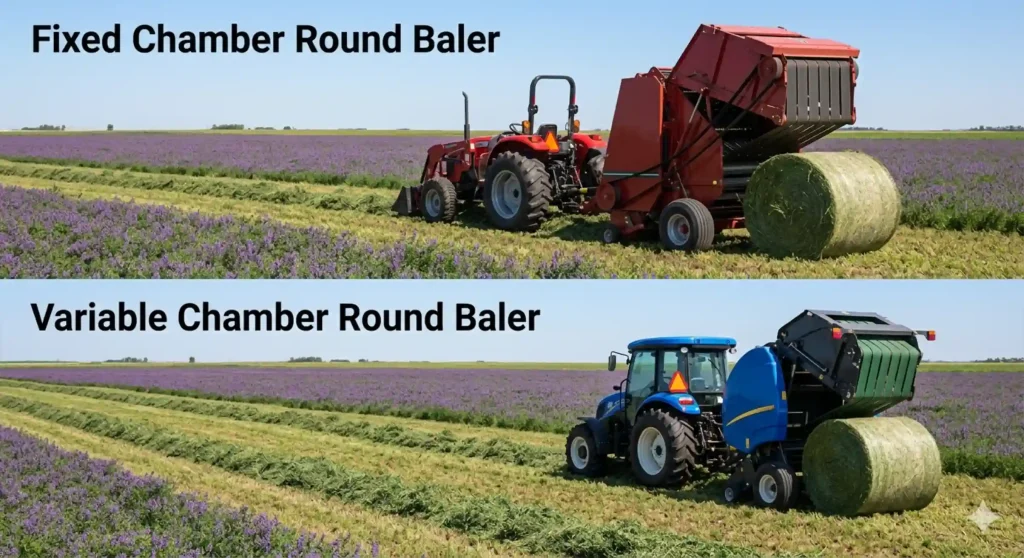
Fixed Chamber Advantages
- Handles wet, heavy crops better: Steel rollers don’t slip on wet forage the way belts can. Silage producers strongly favor fixed chamber designs.
- Lower purchase price: Fewer belts, simpler mechanical design, and fewer adjustment points typically translate to 10–25% lower cost than equivalent variable chamber machines.
- Longer chamber wear life: Steel rollers outlast rubber belts by 2–3x; maintenance intervals are simpler.
- Soft-core bales are easier to feed: Livestock can tear into the softer interior more easily, and the bale crumbles into ring feeders without large flakes falling apart.
- Cleaner operation in mud and debris: Steel construction is less sensitive to foreign material than belt systems.
Variable Chamber Advantages
- Uniform bale density: Every cubic foot of the bale has the same density—critical for commercial transport where density determines freight economics.
- Better weather resistance: Denser outer shell sheds water better, improving outdoor storage life.
- Variable bale size: Flexibility to match bale size to customer preference, handling equipment capacity, or storage constraints.
- Higher bale weight per cubic foot: Denser bales mean more tons per truck—significant for commercial operators shipping long distances.
- Better for dry hay markets: Horse-hay, export hay, and retail hay markets strongly prefer dense, uniform bales.
Which Is Better for Dry Hay?
For producers making dry hay (14–18% moisture), a variable chamber baler generally wins. Uniform density improves weather resistance during outdoor storage, commercial buyers pay premium prices for uniform bales, and the ability to adjust bale size helps match customer requirements.
Which Is Better for Silage and Baleage?
For silage and baleage (35–65% moisture), fixed chamber is typically preferred. Belts can slip under wet-crop conditions, and the softer bale core of fixed chambers actually helps fermentation by allowing slight gas expansion. Many commercial silage operators pair a fixed chamber baler with an inline wrapper for single-pass baleage production.
Decision Framework
Use this quick framework to decide between the two chamber types:
- Predominantly dry hay, commercial sales → Variable chamber
- Predominantly silage/baleage, dairy operation → Fixed chamber
- Budget-constrained, self-use, feeding own livestock → Fixed chamber
- Premium export market, transportation-heavy operation → Variable chamber
- Mixed operation, need flexibility → Variable chamber (slight edge)
Balerhay produces both fixed and variable chamber round balers engineered for global markets. Review the full technical specifications for each model in our 干草打包机系列.
Maintenance Differences to Expect
Fixed chamber balers require periodic replacement of roller bearings and chain drive components—typically every 3,000–5,000 bales. Variable chamber balers require belt replacement every 10,000–20,000 bales, plus bearing service on the tensioning rollers. Both need the same general service on pickup tines, knives, and driveline components.
Plan your parts inventory accordingly. Our catalog includes belts, rollers, bearings, and driveline parts for both chamber types in our 其他产品系列.
Which Chamber Type Matches Your Operation?
Use these quick scenarios to guide your selection:
- Dairy farm producing silage: Fixed-chamber baler with silage-rated rollers. The softer bale core promotes fermentation.
- Commercial dry-hay producer: Variable-chamber belt baler. Dense bales ship efficiently and resist moisture penetration.
- Mixed operation: Variable-chamber with silage capability (available on premium models).
- Small farm with compact tractor: Fixed-chamber mini round baler—mechanically simpler, lower cost to maintain.
常见问题解答
Why do variable chambers cost more? More complex belt and tensioning systems, more bearings, more sophisticated controls. The additional capability justifies 20–40% higher purchase price for operations that benefit from variable bale sizing.
Can I retrofit a fixed-chamber baler to variable? Not practically. The chamber architecture is fundamentally different. Most producers who need variable-chamber capability buy a new variable baler and sell or repurpose the fixed-chamber machine.
How does bale density affect feed value? Denser bales resist weather penetration better but may be slightly harder for livestock to feed from without processing. Density rarely affects nutritional value—it mostly affects storage economics and feeding logistics.
Belt Life & Long-Term Economics
The long-term economics of variable vs fixed chamber balers depend heavily on wear part costs. Variable chamber balers consume more belt material over their service life—typical belt sets cost USD 2,000–4,000 and last 25,000–40,000 bales. Fixed chamber balers replace bearings more frequently but individual parts cost less. Over a 10-year ownership period, total wear part costs typically run USD 6,000–12,000 for variable chamber and USD 3,000–6,000 for fixed chamber, though labor for bearing replacement narrows this gap. Factor ongoing consumables into your purchase decision.
Bale Storage Considerations
Variable-chamber tight bales resist moisture penetration better during outdoor storage, losing only 5–8% dry matter over winter. Fixed-chamber softer bales lose 10–15% in identical conditions. If outdoor storage is mandatory, variable-chamber pays itself back in preserved hay value within 3–5 years.
Resale Value Considerations
Both fixed and variable chamber balers hold resale value well if properly maintained. However, variable chamber balers with documented service history and low belt-hours tend to command a premium in the used market, reflecting higher original cost and continued market demand for tight bales. Fixed chamber balers remain popular in dairy and silage markets where their chamber characteristics are valued. When evaluating future resale, consider both the market demand in your region and the condition/hours the baler is likely to have at sale time.
When selecting between chamber types, the most important factor is not the chamber design itself but the match between chamber type and your specific operation—crop type, storage method, market demand, and volume. Both designs produce excellent bales when correctly matched; neither is universally superior. Consult with experienced local producers about what works in your region’s specific conditions.
Recommended Related Product
🎯 Baler Belt Set (Variable Chamber, 3-Ply Reinforced): Heavy-duty rubber belts engineered for variable chamber round balers. 3-ply construction with fabric reinforcement provides 20,000+ bale service life. Sold as matched sets to ensure even tension and consistent bale formation.
Ready to Make the Right Choice?
Tell us your crop mix, annual bale volume, and target market. Our baler specialists will recommend the optimal chamber type and specific model for your operation. We provide OEM, ODM, and private-label solutions for dealers worldwide.