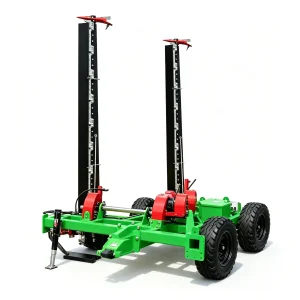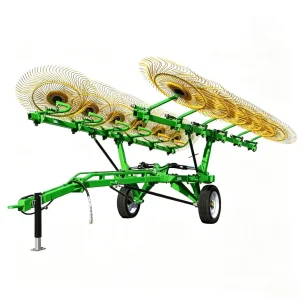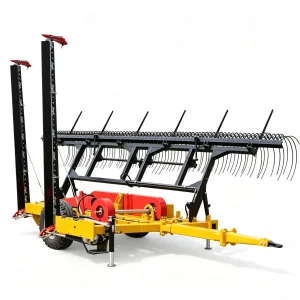
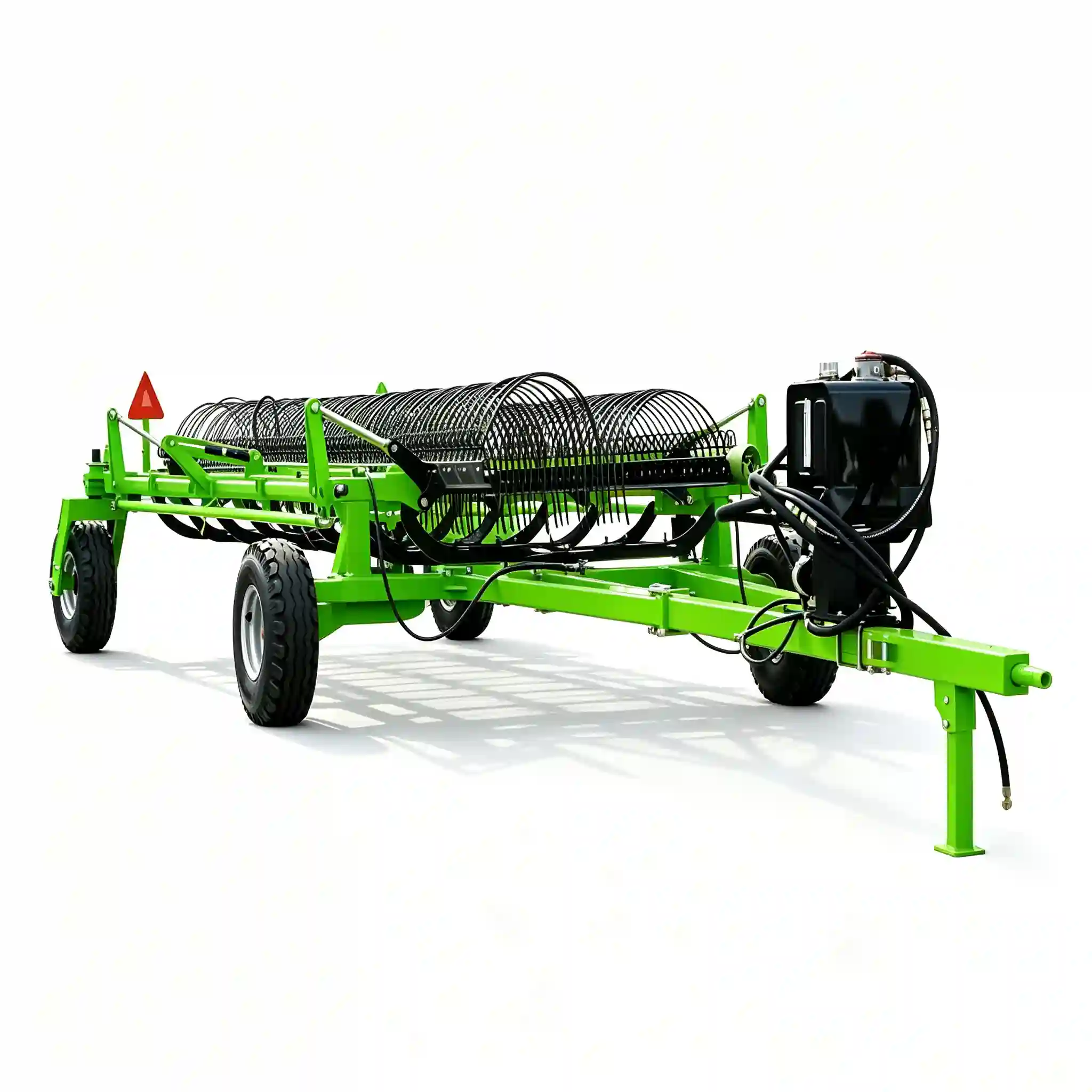
9LH-12 Horizontal Hay Rake for Tractor | Trailed Grass Raking Machine
The 9LH-12 Horizontal Hay Rake sweeps a 12m transverse working width at 5–10 km/h, delivering 6–12 hm²/h with 168 tines and a ≤3% miss rate. Powered by a 25–44kW (35–60hp) tractor, it rakes, turns, and windrows cut forage in one pass. Single-operator hydraulic control.
9LH-12 Horizontal Hay Rake — 12 m Transverse Raking at 6–12 hm²/h
The 9LH-12 Horizontal Hay Rake is a trailed transverse-action raking machine towed by a wheeled tractor rated between 25 kW and 44 kW (35 hp to 60 hp). It sweeps a 12-metre working width in a single pass, gathering cut forage into windrows that run perpendicular to the direction of travel — the defining characteristic of a horizontal-axis rake versus a rotary or finger-wheel design. At 5 km/h to 10 km/h working speed, field productivity ranges from 6 hm²/h to 12 hm²/h, making it one of the highest-output raking options available in the 35–60 hp tractor power class.
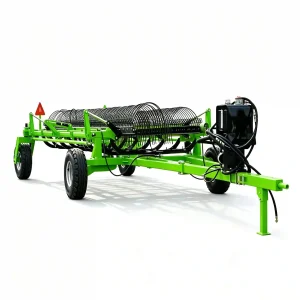
The machine carries 168 individual raking tines across the 12 m bar. Windrow size — width and density — is adjustable by the operator from the tractor seat to match the baler pickup width and the yield per hectare of the standing crop. Rake head lift is controlled via the tractor's hydraulic system: one handle raises or lowers the full 12 m assembly without the operator leaving the cab. The design leaves windrows in a fluffy, open condition that accelerates field drying without damaging the grass root mat — an important quality factor on stands intended for multiple cuts per season.
This hay raking machine is purpose-built for large-area natural grassland and seeded forage operations. Its 12 m swath capacity means it can cover the same area as three or four narrow-width rake passes in one circuit — reducing the number of tractor passes, fuel consumption, and soil compaction events per hectare.
Efficient Hay Raking Solution for Large Grassland Farms
For operations managing 50 ha or more of hay ground per season, pass efficiency is the primary cost driver in the raking phase. The 9LH-12 addresses this directly:
12 hm²/h Peak Throughput
At 10 km/h on flat, open grassland, the 9LH-12 covers 12 hm²/h. A 60 ha block can be raked in a single 5-hour shift. The same area with a 3 m finger-wheel rake would require at least four passes and 15–20 hours of machine time.
Transverse Windrow — Perpendicular to Travel Direction
The rake gathers material into windrows that sit perpendicular to the machine's travel direction. This orientation suits specific baler approaches and field layouts where parallel windrows would require tight headland turns at every pass — the transverse pattern allows the baler to work across the field rather than along it.
Operator-Controlled Windrow Size
The operator adjusts windrow width and density from the cab to match crop yield and baler pickup requirements. In light-yield natural meadow at 1.5 t/ha, tighter windrows prevent baler under-filling; in heavy seeded alfalfa at 5 t/ha, wider, looser windrows prevent pickup blockage. The 9LH-12 accommodates both scenarios in the same machine.
168 Tines — Under 3% Miss Rate
The 168-tine bar achieves a miss rate of 3% or below under standard operating conditions. In practical terms, on a 10 t/ha yield plot, less than 300 kg per hectare is left in the field after the rake pass — within the acceptable loss threshold for commercial forage production.
Hydraulic Lift — Full 12 m Bar in One Handle Movement
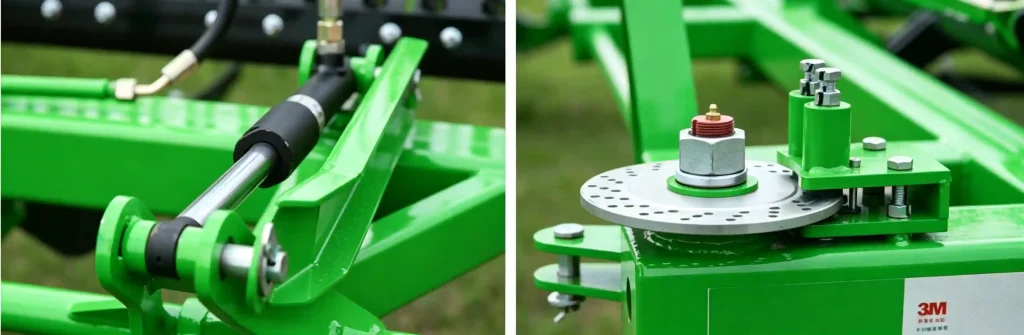
A single hydraulic handle on the tractor raises or lowers the entire 12 m tine bar. Headland turns are completed with the bar fully raised in under 8 seconds. No manual locking, pinning, or cab-exit is required between passes — directly reducing per-hectare headland time on large fields.
Fluffy Windrow — Root System Protected
The horizontal bar action lifts and deposits material gently rather than flicking it at high rotational speed. The resulting windrow is open and aerated — field drying rates are faster than with dense, compressed windrows produced by aggressive rotary rakes — and the grass root mat is not disturbed during the pass.
Technical Specifications of the 9LH-12 Horizontal Hay Rake
Complete parameter reference for procurement teams, dealers, and tractor compatibility verification:
| # | Parameter | Одиниця | Value |
|---|---|---|---|
| 1 | Модель | — | 9LH-12 |
| 2 | Structure Type | — | Tractor-drawn horizontal transverse |
| 3 | Attachment Type | — | Trailed (tow-behind) |
| 4 | Matched Tractor Power | кВт | 25 → 44 (35 hp → 60 hp) |
| 5 | Raking Working Width | м | 12 |
| 6 | Working Speed Range | км/год | 5 → 10 |
| 7 | Field Productivity | hm²/h | 6 → 12 |
| 8 | Number of Raking Tines | шт. | 168 |
| 9 | Miss Rate | — | ≤ 3% |
| 10 | Operators Required | person | 1 |
| 11 | Вага машини | кг | 1510 |
| 12 | Dimensions — Working (L × W × H) | мм | 5500 × 12000 × 1350 |
| 13 | Dimensions — Transport (L × W × H) | мм | 9400 × 3400 × 1750 |
Tractor Hydraulic Note: The rake head lift circuit runs directly from the tractor's hydraulic system — no auxiliary pump is required. Confirm your tractor has at least one rear hydraulic outlet rated for the cylinder load. For compatible agricultural PTO drive shafts and driveline components suited to the 25–44 kW power range, driveshaftjoint.com lists a broad range of stub sizes and torque ratings for tractor-drawn implements.
How Does a Tractor Hay Rake Improve Hay Harvesting?
The raking phase sits between mowing and baling in the hay-making chain. Its quality directly determines bale density uniformity, field dry-down time, and total crop recovery rate. A well-specified tractor hay rake affects three measurable outcomes:
1. Faster Field Drying
Cut forage lying flat in a mown swath dries unevenly — the bottom layer stays moist while the top cures. Raking lifts and turns the material, exposing the previously sheltered underside to sun and airflow. In typical Prairie summer conditions, this can reduce the time to baling moisture (under 18% for round bales) by 8 to 16 hours — a significant reduction in weather-risk exposure during the curing window.
2. Consistent Baler Feed Rate
A uniform windrow of consistent density produces consistent bale weight and shape. Irregular windrows — with gaps from missed material or overly dense clumps — cause the baler pickup to surge and stall. At 168 tines and a ≤3% miss rate, the 9LH-12 produces a dense, gap-free windrow along the full 12 m width, which stabilises the baler feed rate and reduces the chance of in-field stoppages during the baling pass.
3. Higher Total Crop Recovery
Forage left in the field after the rake pass is a direct revenue loss. At a ≤3% miss rate, on a 4 t/ha yield, the 9LH-12 leaves no more than 120 kg per hectare unrecovered. Over 100 ha of season output, that is a maximum of 12 tonnes of unrecovered forage — compared to a poorly adjusted rake operating at 8–10% miss, which leaves 32–40 tonnes in the field.
4. Reduced Tractor Pass Count
Every tractor pass on a hayfield compacts the soil and increases fuel cost. At 12 m working width, the 9LH-12 covers a 60 ha field in as few as 500 passes of 100 m row length. A 3 m rake covering the same field requires approximately 2000 passes. Fewer passes mean less compaction, less fuel per hectare, and a shorter weather-risk window between mowing and baling.
Applications of the 9LH-12 Hay Raking Machine
The 9LH-12 is designed for high-area output on open, flat to gently sloping terrain. As a trailed horizontal hay rake for large farms, its primary use environments include:
- Natural grassland — 50 ha and above: The 12 m working width and 6–12 hm²/h throughput make the 9LH-12 the most practical raking option for large natural meadow operations. A single operator can rake 80 ha per day at 10 km/h — the entire hay ground of a mid-size grassland operation in one shift.
- Canadian Prairie hay farms: The 9LH-12 Horizontal Hay Rake for tractor use suits Canadian Prairie conditions where fields are large, flat, and harvested in a compressed window. The 35–60 hp power requirement covers the majority of utility tractors used in Prairie grassland operations. Fast raking reduces the time cut forage lies in the swath before windrowing, which is critical during unpredictable Prairie weather patterns.
- Seeded forage plots — alfalfa, bromegrass, timothy: The transverse windrow orientation allows the baler to work perpendicular to the mowing direction, which on large seeded plots reduces headland turn frequency and allows longer, straighter baling runs. The fluffy, non-compacted windrow the 9LH-12 produces is particularly well suited to alfalfa, which loses leaf material rapidly when handled aggressively.
- Contract and custom-hire raking operations: At 12 hm²/h peak throughput, a contract operator running the 9LH-12 can service 3–4 client farms per day during peak season. The 1510 kg machine tows behind a standard utility tractor and folds to 9400 × 3400 × 1750 mm for road transport between sites.
- Cooperative grassland management: Cooperatives managing shared hay ground of 200 ha or more can cover the full raking requirement in 17–33 machine hours — achievable in a 2–3 day window with one machine and one operator, even accounting for weather delays and refuelling stops.
Not recommended for: uneven, rocky, or heavily tussocked terrain; waterlogged or boggy ground; dense woodland; and steep slopes where the 12 m bar width cannot follow the ground contour evenly. The transverse windrow pattern also requires field shapes and layouts that allow the baler to work across the rake direction — narrow or irregularly shaped paddocks may reduce efficiency.
Frequently Asked Questions About the Horizontal Hay Rake
What tractor is needed to run the 9LH-12 Horizontal Hay Rake for tractor use?
The matched power range is 25 kW to 44 kW (35 hp to 60 hp). The machine requires one rear hydraulic outlet on the tractor to operate the rake head lift cylinder — no PTO drive is used for the raking action itself; the tines are ground-driven as the machine travels. Tractors below 25 kW may struggle to maintain working speed in dense, heavy crop; tractors above 44 kW are mechanically compatible and offer no improvement in raking quality but can maintain the upper working speed of 10 km/h more reliably in hilly conditions.
How does a horizontal hay rake differ from a rotary or finger-wheel rake?
A horizontal (transverse) rake moves a tine bar laterally across the field, gathering cut forage into windrows that run perpendicular to the direction of travel. A rotary rake uses spinning star-wheel units that produce windrows running parallel to travel. A finger-wheel rake uses a series of angled spinning wheels to merge swaths sideways. The horizontal design tends to handle fine-stemmed grasses and legumes more gently — with less leaf shatter on alfalfa — and produces an open, aerated windrow that dries faster than the compressed windrow a rotary rake can produce at high speed.
Is the 9LH-12 suitable as a grass rake machine for Canadian Prairie large grassland operations?
Yes — provided the ground is firm and relatively flat to gently sloping. The 9LH-12 is designed specifically for large-area natural grassland use. Its 12 m working width and 6–12 hm²/h output make it well matched to Prairie operations where field sizes routinely exceed 50 ha and the harvest window is compressed to 2–5 dry days. The transverse windrow pattern suits open Prairie layouts where the baler can work across the field without tight headland constraints.
Can the windrow size be adjusted, and how is it controlled?
Yes. The operator controls windrow size — both width and density — from the tractor cab during operation. Windrow adjustment matches the baler's pickup width and the yield per hectare of the crop being raked. In low-yield natural meadow, a narrower, denser windrow ensures the baler fills evenly without gaps. In high-yield seeded plots, a wider, looser windrow prevents overloading the baler pickup and reduces blockages. No field tools are required for adjustment.
What is the transport configuration and how does the 9LH-12 move between fields?
In working configuration the machine spans 12000 mm wide. For road transport, the bar folds down to 3400 mm wide — within standard road-width limits in most regions. Transport dimensions are 9400 × 3400 × 1750 mm and the machine weighs 1510 kg. Confirm local road-width regulations before transporting on public roads. The folding mechanism is hydraulically assisted, so no manual bar lowering is required before road travel.
What is the tine replacement interval and are individual tines serviceable?
Individual tines are replaceable — the 168-tine bar does not require a complete assembly swap when tines wear or are damaged by debris contact. Tine life depends heavily on soil contact frequency and debris levels in the field. On clean, low-stone natural grassland, tines typically last two to three seasons. On rougher ground with more abrasive material contact, annual replacement of the highest-wear sections is more common. Spare tine kits should be confirmed at time of wholesale order.
Ready to Upgrade Your Agricultural Equipment Line?
Contact our engineering team today for complete technical drawings and 2026 wholesale pricing on the 9LH-12 Horizontal Hay Rake. Share your target market, annual volume, and tractor specification — we respond within one business day.
Request Technical Drawings & 2026 Pricing
OEM & private-label enquiries welcome · Export documentation included · Spare tine kits available