
Mower Conditioner Basics: Steel Rolls vs Rubber Rolls
Two proven conditioning technologies, very different performance profiles. Here’s how to choose.
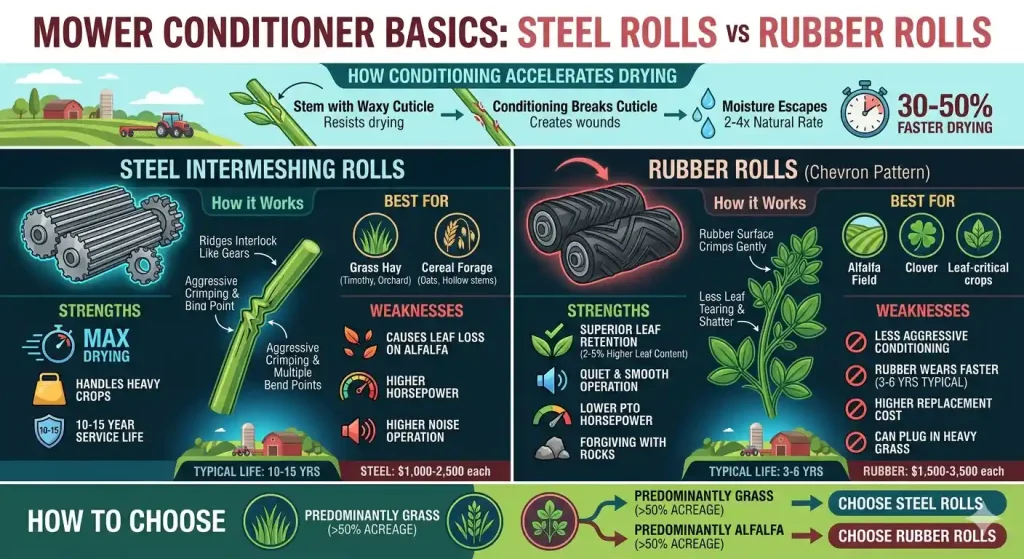
Behind the cutter bar of every modern mower-conditioner sits one of the most important components in the haymaking workflow: the conditioning rolls. These two counter-rotating rolls crush or crimp hay stems as the crop passes through, accelerating drying by 30–50%. For professional haymaking operations, the conditioner is the difference between baling in 36 hours vs 72 hours after cutting — a gap that can decide whether your crop makes it in before the next rain. The mower conditioner rolls come in two main designs: steel intermeshing rolls and rubber rolls. Each has specific strengths, weaknesses, and ideal applications.
What Conditioning Actually Does
Freshly-cut hay dries from two primary surfaces: leaves (dry in 4–12 hours) and stems (dry in 24–60 hours). Leaves drop moisture quickly because their surface-to-mass ratio is high; stems hold moisture because they’re denser and have waxy outer cuticles that resist evaporation.
Conditioning breaks, crushes, or crimps the stem cuticle — creating wounds that let moisture escape at 2–4× the natural rate. This is why a properly-conditioned swath reaches baling moisture 20–40% faster than an unconditioned swath of the same crop.
Design 1: Steel Intermeshing Rolls
Steel Intermeshing Rolls
How it works: Two hardened-steel rolls with ridged or chevron-patterned surfaces rotate in opposition. As hay passes between them, the ridges interlock like gears, aggressively crimping the stems and creating multiple bend points along each stem’s length.
Best For:
Grass hay (timothy, orchard, brome, fescue), cereal forage (oats, wheat, rye), cereal-alfalfa mixes, any crop with hollow stems.
Strengths:
- Aggressive conditioning — maximum drying acceleration
- Excellent performance on grass and cereal crops
- Handles high-volume, heavy crops without plugging
- Long service life — steel rolls last 10–15 years typical
Weaknesses:
- Causes more leaf loss on leaf-fragile crops (alfalfa)
- Higher horsepower requirement at PTO
- Higher noise during operation
Design 2: Rubber Rolls
Rubber Rolls (Chevron or Longitudinal)
How it works: Two rolls covered in vulcanized rubber with chevron or longitudinal ridges rotate in opposition. The rubber surface crimps stems more gently than steel while still creating enough stem damage to accelerate drying. Softer impact preserves leaves on alfalfa and other leaf-critical crops.
Best For:
Alfalfa, clover, alfalfa-grass mixes with substantial alfalfa content, any crop where leaf preservation is the priority.
Strengths:
- Superior leaf retention on alfalfa — 2–5% higher leaf content in finished hay
- Lower noise and smoother operation
- Less PTO horsepower requirement
- Forgiving with rocks and foreign objects (the rubber gives before anything breaks)
Weaknesses:
- Less aggressive conditioning — drying benefit is smaller than steel rolls
- Rubber wears faster than steel — service life typically 3–6 years
- Replacement cost is higher (rubber rolls $1,500–3,500 each vs steel at $1,000–2,500)
- Can plug in very heavy, wet grass crops
How to Choose the Right Mower Conditioner Rolls for Your Crop
The choice almost always comes down to crop type:
- Predominantly alfalfa or alfalfa-mix operations: Choose rubber rolls. Leaf preservation drives quality premium; leaf loss from steel rolls can cost more than the drying advantage is worth.
- Predominantly grass or cereal operations: Choose steel intermeshing rolls. Grass has thicker cuticles that need aggressive conditioning; leaf loss isn’t the concern it is with alfalfa.
- Mixed operations: Steel rolls if grass crops are >50% by acreage; rubber rolls if alfalfa is dominant. A mismatch costs quality on the minority crop but is usually worth it for the majority.
- Custom baling operations: Match to what 80% of your customers grow. Some operators run two mower-conditioners (one of each) but this is rare outside large professional outfits.
Roll Pattern Options
Within each roll type, pattern variations matter:
- Chevron pattern: V-shaped ridges on both rolls. Best material flow — hay moves smoothly through the rolls without wrapping. Most common pattern on both steel and rubber.
- Longitudinal pattern: Straight ridges parallel to roll axis. More aggressive crimping, but higher plugging tendency. Less common; mainly on specialty rolls for very dry conditions.
- Intermeshing tooth pattern (steel): Angled teeth on both rolls that interlock like gears. Maximum aggression. Reserved for heavy grass crops that resist crimping.
Adjusting Roll Pressure
Both steel and rubber conditioner rolls have adjustable pressure (spring tension or hydraulic cylinder-adjusted). Setting it correctly is a quality variable:
- Too little pressure: Hay passes through without adequate conditioning — slow drying result
- Too much pressure: Excessive stem damage, leaf tearing, rolls may skip during heavy inflow
- Correct pressure: Stems visibly crimped at 2–3 cm intervals, but not pulverized. Leaves intact on alfalfa; grass stems broken but not shredded.
Start with the manufacturer’s recommended setting and adjust based on crop results. For operations that process mixed crops, use the lower pressure setting and adjust upward in grass-heavy fields.
Conditioner Impact on Mower Selection
Modern disc mowers are often specified with or without conditioner attachment. The conditioner integrates into the rear of the mower housing, adding weight and complexity but dramatically accelerating drying. For any commercial hay operation, integrated mower-conditioner is almost always the right choice. Stand-alone mowers without conditioner are more appropriate for silage applications (no drying needed), bush-hogging, or very light-duty mowing where the time savings don’t justify the complexity.
Our lawn mower series focuses on rotary and flail mowers for landscape, pasture, and hay-cutting applications. For dedicated commercial hay-production mower-conditioners with integrated rolls, contact our sales team for specification guidance.
Maintenance Considerations
Both roll types need routine maintenance:
- Steel rolls: Inspect for wear pattern unevenness, chipped edges, bent rolls. Replace when ridges wear to less than 50% of original profile height.
- Rubber rolls: Inspect for cracks, splits, rubber separation from core. Replace at first signs of rubber degradation — rubber rolls don’t fail gracefully.
- Both types: Check roll bearings annually. Failed bearings destroy rolls rapidly and can damage surrounding mower components.
- Drive belts and chains: Inspect tension at season start; replace worn components before they fail in the field.
Replacement roll bearings, drive-belt kits, and associated conditioner components for major brands are stocked in our other product series.
The Cost-Benefit for Dedicated Alfalfa Operations
For a 400-acre dedicated alfalfa operation, upgrading from steel rolls to rubber rolls on the mower-conditioner can be worth $15,000–25,000 annually. The logic: rubber rolls preserve an extra 3–4% leaf content. On 400 acres × 3 cuts × 2 tons/acre = 2,400 tons of hay at $250/ton premium pricing, that’s $2.4M annual hay revenue. A 3% quality improvement moves more of that hay from Good grade ($195/ton) to Premium grade ($245/ton) — worth $50/ton × 1,200 tons that shift grade = $60,000/year. Net of rubber roll replacement cost amortized over 4-year service life, operations routinely net $15,000–25,000/year from the upgrade.
Common Mistakes in Conditioner Setup
Even with correct mower conditioner rolls selection, setup mistakes can negate the advantage. The five most common:
- Roll gap too tight: Excessive stem crushing that reduces hay to mash. Set gap per manufacturer spec — usually 2–4 mm at full-contact chevron points.
- Roll gap too loose: Hay passes through without adequate conditioning. Drying benefit disappears. Check gap with feeler gauge at season start.
- Worn or damaged rolls: Ridges that have worn to flat spots don’t condition — they just pass hay through. Replace rolls when ridge profile shows <50% of original depth.
- Imbalanced roll pressure: Uneven pressure left-to-right causes lopsided conditioning. Check pressure-adjustment springs or hydraulic cylinders for equal tension.
- Roll timing out of phase: On chevron pattern rolls, the peaks on the top roll should mesh with valleys on the bottom roll. Mistimed rolls pound hay rather than crimp it.
Drying Rate Measurements
Measuring the effect of conditioning is straightforward: after cutting with and without conditioning (or with steel vs rubber rolls), test swath moisture every 12 hours. A well-conditioned swath drops moisture 2–4 percentage points faster than unconditioned, compounding over 48 hours to the full day’s drying advantage described earlier. Operations curious about their own equipment performance can do this test in a single field in two sessions, getting quantitative data specific to their conditions.
Recommended Companion Product
Conditioner Roll Replacement Kit — Complete roll sets in steel and rubber for major mower-conditioner brands. Precision-machined for OEM compatibility. Includes matched bearings, drive sprockets, and installation hardware.
Match Your Conditioner to Your Crop — Talk to an Expert
Replacement rolls, complete conditioner units, and advisory sizing — every brand, every crop.