
The Evolution of Hay Baling Machines: From Hand Press to Modern Round Baler
The history of the hay baler is a story of agricultural transformation. In less than 150 years, hay making has evolved from back-breaking hand labor with pitchforks and wooden boxes into a highly mechanized process where a single operator can put up hundreds of tons of forage per season. Understanding this evolution helps today’s buyers appreciate which modern features actually matter and which are marketing fluff.
The Pre-Baler Era: Loose Hay and Hay Presses
Before mechanical baling, farmers worldwide stored hay loose—in haystacks, lofts, or barns. Loose hay was inefficient: it required massive storage volume, spoiled rapidly when wet, and was labor-intensive to handle. By the mid-1800s, stationary hay presses emerged. These were manually or horse-powered devices that compressed loose hay into bundles, which were then tied by hand with rope or wire. The earliest U.S. patents for hay presses date to the 1850s.
Hay presses remained stationary machines. Farmers brought hay to the press rather than the other way around. A team of workers could produce perhaps 50–100 bales per day, with every bale tied manually—a significant advance over loose hay, but still constrained by human labor.
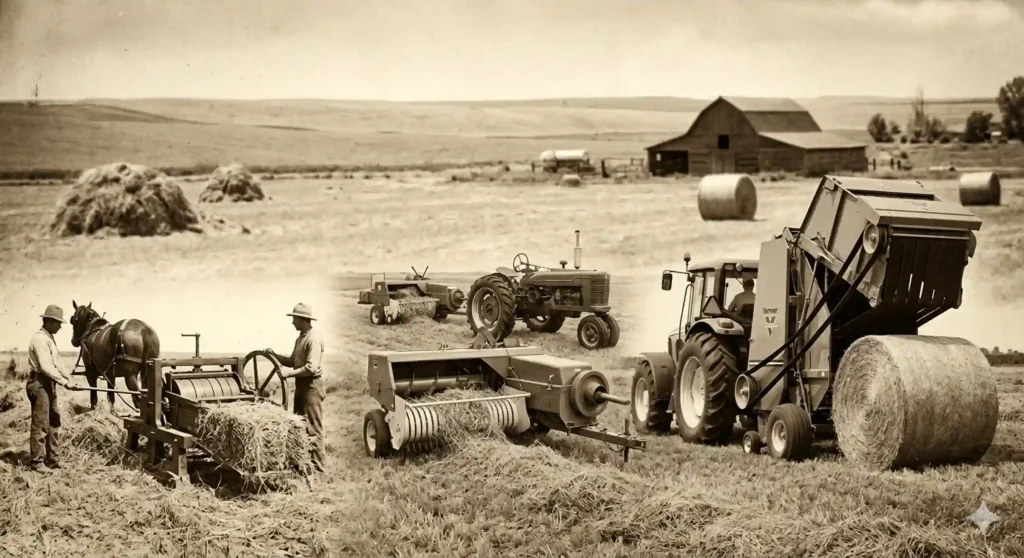
The Invention of the Automatic Square Baler
The true revolution came in 1938, when Arthur Young patented the first commercially successful automatic pickup baler—the Automaton Baler. Young’s machine automated the tying step using mechanical knotters, eliminating the single greatest labor bottleneck. New Holland Ag acquired the Young design, and by the 1940s the automatic small square baler had the architecture we still recognize today: a pickup reel, a feeding system, a plunger-driven compression chamber, and automatic twine knotters.
In Europe, Claas of Germany and Rousseau SA of France introduced similar pickup balers in 1939. The International Harvester square baler—mass-produced after World War II—became ubiquitous across American farms. The first hay baling machine architecture proved so successful that modern small square balers remain structurally similar more than 80 years later.
The Rise of the Round Baler
While square balers dominated post-war haymaking, inventors continued pursuing an alternative: a round bale that shed rain and didn’t require indoor storage. Ummo Luebben conceived a round baler concept around 1910, but production machines did not appear until 1947, when Allis-Chalmers introduced the Roto-Baler. The Roto-Baler produced small, water-shedding cylindrical bales and sold nearly 70,000 units before production ended in 1960.
The modern round baler arrived in 1972 when Gary Vermeer of Pella, Iowa designed the Vermeer 605 using belts to compact hay into a cylindrical shape—the same architecture still used today. The 605 produced bales about 5 ft in diameter weighing roughly 600 lb. Within three years, 15 American and Canadian manufacturers were producing large round balers, and the market transformation was permanent. The invention of the round baler fundamentally changed how commercial hay was stored and handled.
PTO Drivelines and CV Joints: The Hidden Revolution
Alongside baler evolution, power transmission underwent its own revolution. Early balers ran on belt drives from tractor pulleys or their own mounted engines. The shift to PTO power—using 540 RPM tractor output—required robust drivelines capable of handling significant torque.
In the early 1980s, Walterscheid engineer Martin Brown pioneered the use of constant-velocity (CV) joints in baler drivelines. This solved the vibration and premature wear problems caused by the heavy torque of round baler operation at sharp angles. Double cardan CV joints remain standard on modern high-output balers—see our latest compact and commercial baler models in the Höbalpressserien.
Mini Balers and the Compact Tractor Era
Starting in the late 1990s, Japanese and Italian manufacturers began producing mini round balers sized for compact tractors of 15–50 HP. These machines produce small bales of roughly 20×28 in weighing 40–65 lb—easily handled by one person. They opened hay production to hobby farmers, homesteaders, horse owners, and small operations previously locked out of mechanized haymaking.
This miniaturization trend mirrors what occurred with hay rakes. A well-matched compact tractor, rake, and mini baler now produces hay at a scale that was simply impossible 30 years ago. Explore compatible compact equipment in our Hökracka-serien.
Modern Innovations in Hay Baler Development
Recent decades have seen incremental but important advances in hay baler development:
- Net wrap replaces twine for most commercial round bales, reducing bale weight loss and wrap time.
- On-board moisture sensors tell the operator in real time whether hay is too wet for safe storage.
- Bale weight sensors document each bale’s mass for commercial accounting and transport planning.
- Inline bale wrappers combine baling and silage wrapping into a single pass, saving 30–50% of labor.
- ISOBUS connectivity gives operators in-cab control of every baler function via a single display.
What the History Tells Us About Buying a Baler Today
Looking at the arc from 1850s hay press to 2026 ISOBUS-controlled baler, one pattern repeats: the most successful balers are those with robust, easily-serviced mechanical cores. Flashy electronics come and go, but rollers, belts, gearboxes, and bearings are what actually make or break a baler’s service life. When evaluating modern balers, prioritize mechanical durability and spare parts availability over dashboard gadgets.
Key Historical Milestones at a Glance
- 1850s: First hay press patents in the United States; manual compression, manual tying.
- 1890s: Stationary steam-powered hay presses begin appearing on large commercial farms.
- 1929: Ann Arbor Company produces the first mobile pickup baler.
- 1938: Arthur Young patents the first commercially successful automatic knotter system.
- 1947: Allis-Chalmers introduces the Roto-Baler—first commercial round baler.
- 1972: Vermeer Model 605 launches the modern belt-driven round baler era.
- 1980s: Walterscheid/Vermeer collaboration brings CV joint drivelines to standard production.
- 1990s: Net wrap replaces twine as the dominant binding method.
- 2000s: Continuous-bale designs allow baling without stopping.
- 2010s–present: ISOBUS integration, moisture/weight telemetry, and precision baling.
Lessons from 150 Years of Baler Evolution
Three lessons emerge from baler history that remain relevant for today’s buyers. First, successful designs evolve incrementally rather than through disruptive rewrites—the core architecture of both square and round balers has remained stable for decades. Second, mechanical durability trumps electronic sophistication for long-term service life. Third, spare parts availability determines whether a baler is a lifetime investment or a disposable tool. When buying any baler today, apply these lessons: favor proven mechanical designs, prioritize parts support, and be skeptical of “revolutionary” marketing claims.
What the Future Likely Holds
Looking forward, three trends are shaping the next decade of baler development. First, deeper data integration—moisture telemetry, bale weight logging, GPS-tagged bale tracking for traceability. Second, increased automation—continuous bale formation, automated wrap loading, and tractor-guidance integration that lets balers operate with reduced operator attention. Third, electrification—initially in small mini round balers powered by battery-electric compact tractors, eventually scaling to larger commercial units. Smart buyers evaluate not just today’s baler but how it fits the technology trajectory over a 10–15 year ownership period.
Why History Matters for Buyers Today
Understanding baler history helps buyers make smarter decisions today. The fundamental architecture of round and square balers has been stable for decades, which means there is deep engineering knowledge and extensive parts availability for mature designs. Newer technology—ISOBUS integration, moisture telemetry, continuous-bale systems—adds value for commercial operators but isn’t required for most haymakers. History also reveals which brands have stayed committed to parts support across generations and which have abandoned legacy models, a critical factor when evaluating used balers with 10+ year service life potential.
Recommended Related Product
🔩 Heavy-Duty PTO Shaft with CV Joint: Modern constant-velocity driveline based on the 1980s Walterscheid/Vermeer design that revolutionized baler drivetrains. Rated for 540 RPM continuous operation, supports sharp articulation angles without vibration or premature U-joint wear. Ideal retrofit for balers, mowers, and rakes.
Experience the Next Generation of Hay Balers
At Balerhay, we combine 80+ years of baler engineering heritage with modern manufacturing precision. Our round balers are designed to deliver the reliability of legacy designs with today’s efficiency gains. Request our product catalog to see how we help dealers worldwide serve farms of every size.
editor:WM