
Hay Baler Gearbox Explained: Types, Working Principle & How to Select One
Every round baler, square baler, and forage harvester in the world relies on one critical internal component to function: the hay baler gearbox. The gearbox is the mechanical heart of the baler—converting the tractor’s 540 RPM PTO input into the precise speeds and torque required by the pickup reel, rotor, chamber drive, and wrap mechanism. When the gearbox fails, the entire baler stops. Understanding how baler gearboxes work, the different types available, and how to select the right one is essential for procurement teams, dealers, and service technicians.
What a Baler Gearbox Does
A baler’s primary input gearbox receives rotation from the PTO shaft and distributes that power to multiple output shafts, each driving a different baler subsystem at a different speed. The gearbox may also change the direction of rotation (90° for many inputs) and apply torque multiplication—a reduction ratio that trades speed for force. Typical baler gearbox ratios range from 1:1 straight-through drive to 3:1 reduction for high-torque chamber drives.
Baler gearbox types fall into several categories based on gear geometry:
- Bevel gearbox: Uses straight-cut or spiral bevel gears to change rotation direction by 90°. The classic “T-box” found on most round balers at the PTO input.
- Spiral bevel gearbox: Higher torque capacity and quieter operation than straight bevel. Standard on commercial balers.
- Hypoid gearbox: Offset input and output shafts for design flexibility. Found on some specialty balers.
- Helical gearbox: Used for parallel-shaft reduction. Common in chain-drive final reductions inside the baler.
- Planetary gearbox: Compact, high-torque. Occasionally used in heavy-duty baler rotor drives.
The Round Baler Gearbox in Detail
A typical round baler gearbox has one PTO input and two to four outputs. The primary output drives the main chamber roller or belt pulley. Secondary outputs drive the rotor (feeding system) and pickup reel. On some designs, a third output drives the wrapping mechanism.
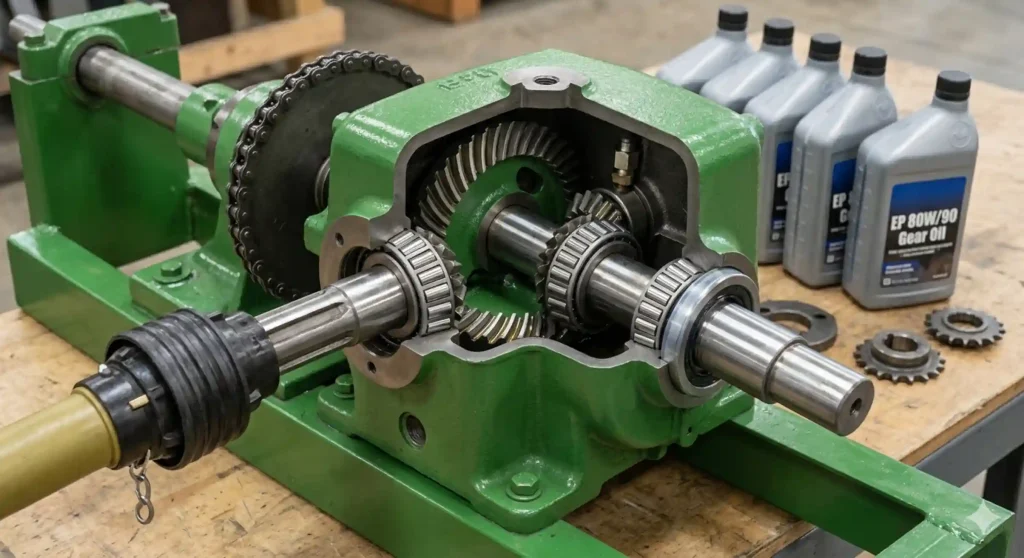
Internally, the gearbox is a sealed cast-iron or cast-aluminum housing containing case-hardened bevel or spiral bevel gears (typically 8620 or equivalent alloy steel), tapered roller bearings on input and output shafts, oil seals preventing gear-oil leakage and contamination ingress, a breather valve equalizing internal pressure as the gearbox heats up, and a drain plug and fill plug for oil service.
Gearboxes are lubricated with EP 80W/90 gear oil in most North American designs, or SAE 90 in European designs. Oil must be changed annually or per the manufacturer’s hour interval, whichever comes first. You can see examples of modern balers with factory-specified gearbox assemblies in our Серия пресс-подборщиков сена.
Why Gearbox Failure Happens
Hay baler gearboxes are designed to run for 2,000–10,000 hours when properly maintained. Most premature failures trace back to a short list of causes:
- Low oil or wrong oil: Operating with too little oil—even briefly—overheats gears and causes pitting. Using automotive gear oil instead of EP-rated agricultural oil does the same.
- Ingress contamination: Damaged seals let water, chaff, or dust in, which acts as an abrasive and destroys bearings within hours.
- Misaligned PTO shaft: Running the PTO at angles beyond the shaft’s rated articulation creates cyclical loading on the input shaft, causing bearing or seal failure.
- Shock loading: Slip clutches or shear bolts must be set correctly; a locked-up clutch transfers full overload torque directly into the gearbox, cracking gear teeth.
- Over-speed operation: Running a 540 RPM gearbox at 1000 RPM can melt internal seals and warp gears within minutes.
Selecting a Replacement Baler Gearbox
When sourcing a replacement agricultural gearbox for a baler, match these specifications:
- Horsepower rating: At least 20% above the implement’s rated HP to provide safety margin
- Input/output speed: 540 or 1000 RPM input; verify output RPM matches the driven component
- Reduction ratio: Match original gearbox exactly—even a 10% ratio change can cause bale formation problems
- Shaft dimensions and spline type: Verify hex, spline, and keyway dimensions match the original
- Housing mounting pattern: Bolt-hole locations and orientation must match the baler frame
- Output direction: Clockwise or counter-clockwise rotation must match the original
Note that the same gearbox families are often used across multiple implement categories—so a gearbox spec’d for a baler may also fit rotary cutters and flail mowers. View our mower lineup in the Серия газонокосилок to see cross-compatible gearbox applications.
OEM vs Aftermarket: What to Expect
OEM gearboxes are made by the original equipment manufacturer and typically command a 30–200% price premium. Quality aftermarket gearboxes—manufactured on the same casting and gear-cutting equipment—deliver equivalent performance at significantly lower cost. The critical factors are: does the manufacturer use the same gear material (8620 or equivalent), the same bearing specifications (SKF or Timken-equivalent), and the same sealing standards? Reputable suppliers will share these details openly.
Hay Baler Transmission: Beyond the Gearbox
The term “hay baler transmission” encompasses more than just the input gearbox. It includes the chain drives, belt drives, sprockets, and secondary gearboxes that distribute power throughout the baler. Most round balers use a combination: a primary input gearbox, a heavy-duty chain from the gearbox output to the chamber drive, and smaller chains to the pickup and rotor. Maintaining all components in this transmission chain is essential—weak chains or worn sprockets create load spikes that ultimately fail the gearbox.
Signs Your Baler Gearbox Needs Service
- Grinding or whining noises from the gearbox during operation
- Visible oil leakage from output shafts or housing joints
- Excessive heat on the gearbox exterior (above 80°C / 175°F)
- Metal particles visible on the oil drain plug magnet
- Oil appearance darkened, milky, or smells burnt
- Detectable play on output shafts when baler is stopped
Часто задаваемые вопросы
Can I rebuild a failed baler gearbox? Usually yes, if the housing is intact. Gears, bearings, and seals are individually replaceable. However, rebuild labor cost often exceeds 60% of a new gearbox—weigh both options carefully. OEM quality aftermarket gearboxes are frequently the most cost-effective solution.
How often should I change the gearbox oil? Manufacturer specs vary, but annually or every 500 operating hours (whichever comes first) is a safe rule. Some commercial operators change oil at season start and season end to maximize protection.
Why did my gearbox fail after only 2 seasons? Common early failures trace to: running low on oil, operating with damaged seals allowing dirt ingress, severe overload events (often caused by blocked slip clutches), or wrong oil type. True manufacturing defects are rare in established gearbox brands.
Protect Your Gearbox Investment
Most baler gearbox failures are preventable. Follow these five rules: (1) Change oil annually or per manufacturer specs—fresh oil protects against condensation corrosion during storage. (2) Never operate with low oil—even short runs damage gears permanently. (3) Keep seals intact—replace at the first sign of weeping. (4) Respect the slip clutch or shear bolt—don’t defeat overload protection. (5) Avoid operating at extreme angles beyond specification. A gearbox treated well delivers 10,000+ hours of service; a neglected gearbox may fail in 500 hours or less.
Working With Your Dealer’s Parts Team
For any baler gearbox repair or replacement, work closely with a knowledgeable parts specialist who can cross-reference OEM part numbers, identify compatible aftermarket alternatives, and advise on reman-versus-new tradeoffs. Experienced parts teams often save significant money by knowing which gearbox families are interchangeable across implement categories and which premium OEM parts have direct aftermarket equivalents. Building a relationship with a reliable parts specialist is one of the best investments a baler owner can make.
Recommended Related Product
⚙️ Baler Gearbox (540 RPM Input, 1:1 or 1.5:1 Ratios Available): Cast-iron housing, spiral bevel gearing in 8620 alloy steel, Timken-equivalent tapered bearings, and Viton oil seals. Direct replacement for major-brand round baler gearboxes. Each unit includes 90-day run-in warranty with documented test certification.
Source Reliable Baler Gearboxes
A reliable gearbox is the difference between a productive baler and a field full of frustration. Balerhay supplies agricultural gearboxes for balers, rakes, and mowers worldwide, with quick-ship inventory on the most common replacements and custom manufacturing for OEM partners.