
The Haymaking Weather Window: Reading Forecasts for Quality
Every experienced hay producer knows the saying: “Hay is a weather crop.” More than any other field crop, the quality of hay is determined by the 36–72 hour window between cutting and baling — a window entirely controlled by weather. Reading forecasts accurately and translating them into cutting decisions is one of the most valuable skills in haymaking. Understanding the haymaking weather window is what separates operators who consistently produce top-grade hay from those who accept whatever nature delivers. This guide lays out how to interpret weather forecasts specifically for haymaking, what variables matter most, and how to decide when to cut.
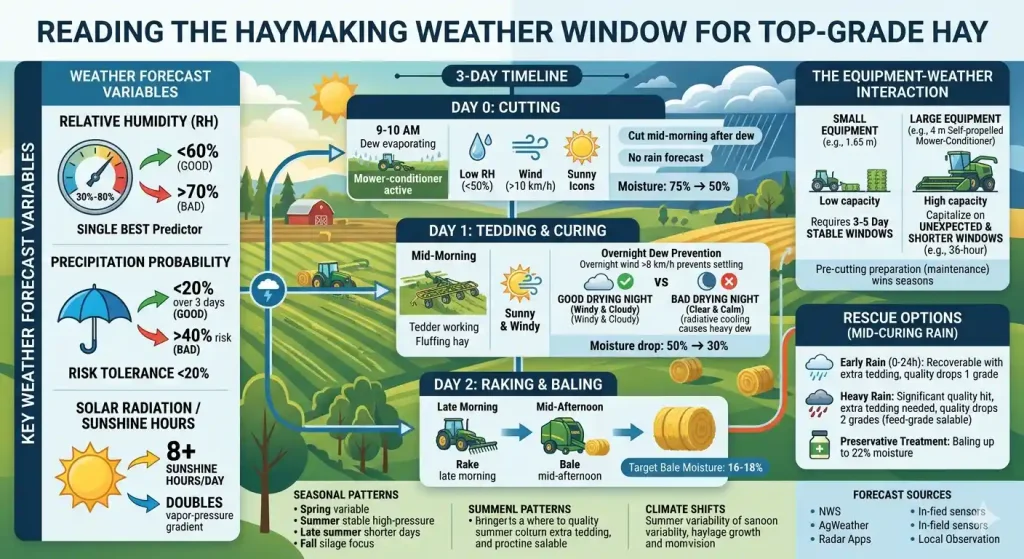
The Curing Cycle and Weather Requirements
Freshly-cut hay drops from 70–80% moisture to baling-ready 16–18% moisture through evaporation driven by ambient air conditions. The required time depends on weather:
☀️ Ideal Conditions
Temperature 26–32°C, humidity <50%, wind 10–20 km/h, full sun. Curing time: 24–36 hours. The three-day window can easily handle first-cut alfalfa with conditioner.
🌤️ Good Conditions
Temperature 22–26°C, humidity 50–65%, light wind, mostly sunny. Curing time: 36–48 hours. Need to start early and use tedder to stay ahead of schedule.
⛅ Marginal Conditions
Temperature 18–22°C, humidity 65–75%, variable wind. Curing time: 48–72 hours. Tedding mandatory; watch for overnight dew delays. Small baled formats preferred.
🌧️ Poor Conditions
Temperature <18°C, humidity >75%, rain probability >30%. Don’t cut. Either wait for better weather or plan for silage/haylage instead of dry hay.
The Three Variables That Matter Most
Of all the weather variables in a typical forecast, three are most relevant for haymaking decisions:
- Relative humidity. The single best predictor of drying speed. At 30% RH, hay loses moisture at 3× the rate it does at 80% RH. Look for extended periods (24+ hours) of humidity below 60% during the day.
- Precipitation probability. A 20% chance of rain over 3 days is acceptable; 40%+ at any point in the 3-day window is too risky. Check radar-based nowcasts on day-of for actual precipitation signatures.
- Solar radiation / sunshine hours. Direct sunlight accelerates surface evaporation and raises hay temperature, doubling the vapor-pressure gradient that drives moisture out. 8+ sunshine hours per day is the baseline target.
Temperature matters but less than the above three. A 28°C day with 70% humidity dries slower than a 22°C day with 45% humidity. Temperature without low humidity is not enough.
Reading a 3-Day Forecast for Haymaking
The practical framework for a 3-day haymaking window:
Day 0 (cutting day): Cut in mid-morning after dew evaporates, typically 9–10 AM. Target a day with RH dropping to <50% by early afternoon, temperature >24°C, winds 10+ km/h. No rain in forecast.
Day 1 (tedding/curing): Continued good conditions. Morning dew burns off by 9–10 AM. Ted in mid-morning once surface is dry. Target: swath moisture dropping from 45% (overnight) to 25% by evening.
Day 2 (raking and baling): Rake in late morning, bale in mid-afternoon. Target: moisture at 16–18% during baling window. Morning temperature recovery and continued low humidity make this the highest-quality baling window.
Dew: The Overnight Variable
Dew forecast for haymaking is often overlooked but critical. Heavy dew on freshly-cut hay during the first two nights can add 15–20 percentage points of moisture back to the crop, requiring a full day of recovery to re-dry. Factors affecting dew formation:
- Clear skies at night promote radiative cooling of hay surface below dew point — dew forms
- Cloudy nights stay warmer — less dew
- High humidity at sunset with rapid temperature drop = heavy dew
- Wind overnight (>8 km/h) prevents dew settlement — look for windy nights
The best hay-drying nights are windy with cloud cover — counterintuitively not the picture-perfect starry-sky nights that make the hay look prettiest in the field. Experienced operators check not just precipitation forecasts but wind forecasts specifically to predict dew conditions.
Hay Curing Weather Patterns
Hay curing weather in most temperate regions follows a predictable seasonal pattern:
- Late spring (first cutting): Weather often variable. Windows of 3 good days are less common. Focus on early-cutting discipline and be willing to take marginal weather when it appears.
- Mid-summer (second and third cuttings): Peak haymaking season. Stable high-pressure systems deliver extended good windows. Most operations make their best hay in June–early August.
- Late summer (late cuttings): Shorter days reduce solar radiation. Morning dews are heavier. Windows get shorter as season progresses. Last-cut quality is often a production-vs-quality tradeoff.
- Fall (stockpiled forage): Cool-season conditions favor silage/haylage over dry hay. Acceptable weather windows become rare.
Forecast Sources and How to Use Them
Modern haymaking operators use multiple forecast sources:
- National weather service (NWS / Environment Canada / national equivalents): Most accurate for 3–5 day outlooks. Free access, reliable quality. The baseline source.
- AgWeather specialized services: DTN AgWeather, Climate FieldView, local co-op forecasts. Field-level precision at small cost. Often include haymaking-specific recommendations.
- Radar apps: Base Reflectivity / BaseVelocity radar images for real-time precipitation tracking during a curing window. Essential on days with scattered shower probability.
- Soil temperature and humidity sensors: In-field sensors reporting real-time conditions. Most useful for large operations with multiple fields at different exposures.
- Local observation: Your own field observations — cloud cover, wind shifts, barometric pressure from a garage-mounted barometer — refine the official forecast. Weather is local; forecasts are regional.
The Weather-Equipment Interaction
Equipment capability affects what weather windows you can use. A small operation running a 1.65 m mower can only cut 15–20 acres per day — requiring 3–5 day stable windows to cut substantial acreage. A large operation running a 4 m self-propelled mower-conditioner can cut 150+ acres per day, making 36-hour windows productive. Right-sizing equipment for your farm scale matters for weather flexibility as well as simple throughput.
Similarly, pre-cutting preparation speeds response to opportunities. Properly-maintained equipment — mower ready to cut, rake calibrated, baler lubricated — lets you capitalize on unexpected good windows. Deferred maintenance loses days that cost quality. Keep driveline components (PTO shafts, gearboxes, clutches) in working order — browse our other product series for replacement parts. Mower readiness specifically depends on cutter-bar condition and drive components from our lawn mower series.
When the Window Closes: Rescue Options
Sometimes weather breaks on you mid-curing. Options:
- Light rain during early curing (0–24 hours post-cut): Not a disaster. Ted the next dry day to release trapped moisture. Quality drops 1 grade but hay is recoverable.
- Heavy rain during curing: Significant quality hit. Allow to re-dry; may need extra tedding passes. Quality may drop 2 grades — still salable as feed-grade hay.
- Extended wet weather (>48 hours of rain): Major loss risk. Consider switching production to silage by wrapping at high moisture, or accept heavy losses.
- Preservative-treated baling: Propionic acid-based preservatives allow baling up to 22% moisture. Expensive but can save hay that would otherwise rot.
The real lesson from weather disasters: don’t cut more than you can handle in the forecast window. Cutting disciplined matching of acreage to weather capability is the single biggest risk-reduction practice in haymaking.
Decision-Framework Examples from Real Operations
Applying haymaking weather window principles in practice means making judgment calls with imperfect information. Two realistic scenarios illustrate the decision process:
- Scenario A: Forecast shows 72 hours clear, low-humidity, 27°C average. Day 4 brings 40% chance of thunderstorms. An operator with 60 acres to cut and mower-conditioner capability covers the field in day 1, tedding is done by afternoon of day 2, raking and baling complete by evening of day 3 — ahead of the weather change. Classic successful execution.
- Scenario B: Same forecast, same operator, 200 acres to cut. Cutting 60 acres/day means the last acres are cut on day 3 — with only 24 hours before potential rain. The right decision is to cut only 100–120 acres, accept a split baling schedule with the remainder waiting for the next good window, and avoid the risk of rain-damaging the later-cut portion. Many operations learn this lesson the hard way before accepting it.
Climate Change Considerations
Regional climate patterns are shifting. In many traditional hay-producing regions, summer weather has become more variable — longer dry periods interspersed with intense rain events. The implications for haymaking:
- Reduced predictability makes conservative cutting discipline more important
- Value of wider equipment rises, because productive windows are shorter
- Interest in haylage/silage grows in historically-dry-hay regions
- Storage protection becomes more valuable as intense-rain events damage uncovered hay more severely
Recommended Companion Product
Digital Hay Moisture Tester — Probe moisture tester for in-field verification of forecast-driven curing estimates. Digital display, ±1% accuracy, 12-inch probe, battery-powered. Essential for weather-driven baling decisions.
Equip for Every Weather Window — Fast Response Wins Seasons
Moisture testers, probe thermometers, driveline parts, mower components — everything you need to capitalize on weather windows.