Hay Moisture Content 101: Why It Matters for Baling
Moisture content is, without exaggeration, the single most important variable in hay production. Get it right and you bale beautiful, fragrant, nutritious forage that your animals thrive on and your customers pay a premium for. Get it wrong and you either spoil months of effort in a mold-infested bale pile—or set your barn on fire. This guide explains hay moisture content for baling, shows what moisture targets to aim for, and tells you how to measure and control moisture in the field.
Why Moisture Content Matters So Much
Fresh-cut forage contains roughly 75–85% water. Hay for dry storage must be baled between 12% and 20% moisture, depending on bale size and density. If hay is baled above this range, microbial fermentation begins inside the bale. Fermentation generates heat. If the heat rises above 65°C (150°F), hay molds extensively and loses nutritional value. If it rises above 75°C (170°F), spontaneous combustion is possible—thousands of barn fires every year are caused by hay baled too wet.
Conversely, hay baled too dry (below 12%) loses so many leaves during handling that its nutritional value collapses. Alfalfa baled below 10% moisture can shed 50% of its leaves during baling and handling, turning a premium forage into cattle-grade feed.
Ideal Moisture Content for Each Bale Type
The ideal moisture for baling hay depends on bale density—the denser the bale, the drier the hay must be (because a denser bale restricts internal air flow and heat dissipation).
Here is a practical hay moisture content chart used by extension specialists worldwide:
- Small square bales (14×18 in): 18–22% moisture
- Mini round bales (20×28 in): 15–20% moisture
- Standard round bales (4×4 to 4×5 ft): 14–18% moisture
- Large square bales (3×3 to 4×4 ft): 12–16% moisture
- Silage / baleage (wrapped): 40–65% moisture
Silage bales operate on an entirely different principle: after baling, they are wrapped in airtight plastic film and ferment anaerobically into high-quality preserved feed. This is why silage hay moisture can be much higher than dry hay.
When to Bale Hay: Timing the Harvest
Beyond moisture, timing affects quality in many ways. The question “when to bale hay” has several components:
- Plant maturity: Cut grass hay at the early-head stage; cut alfalfa at early-bloom. Cutting too late collapses nutritional value.
- Time of day: Midday baling—after dew has evaporated but before afternoon humidity rises—is ideal. Early-morning baling is tempting but often results in hay that’s wetter than it appears.
- Weather window: You need roughly 3 consecutive dry days for dry-hay operations (cut day 1, ted and rake day 2-3, bale day 3). Silage operations need less—often 1–2 days.
- Forage testing: Squeeze a handful of hay and twist. If liquid appears, moisture is above 40%. If the stems bend without snapping, moisture is 30–40%. If stems snap cleanly, moisture is below 20% and ready to bale.
How to Measure Hay Moisture
Subjective tests (squeeze, twist, feel) work for experienced hay makers, but they’re unreliable for critical decisions. Three more accurate methods:
- Probe moisture meter: A handheld spike inserted into a windrow or completed bale returns a digital moisture reading. Accuracy ±1–2%. Cost: USD 150–500. Essential for any commercial operation.
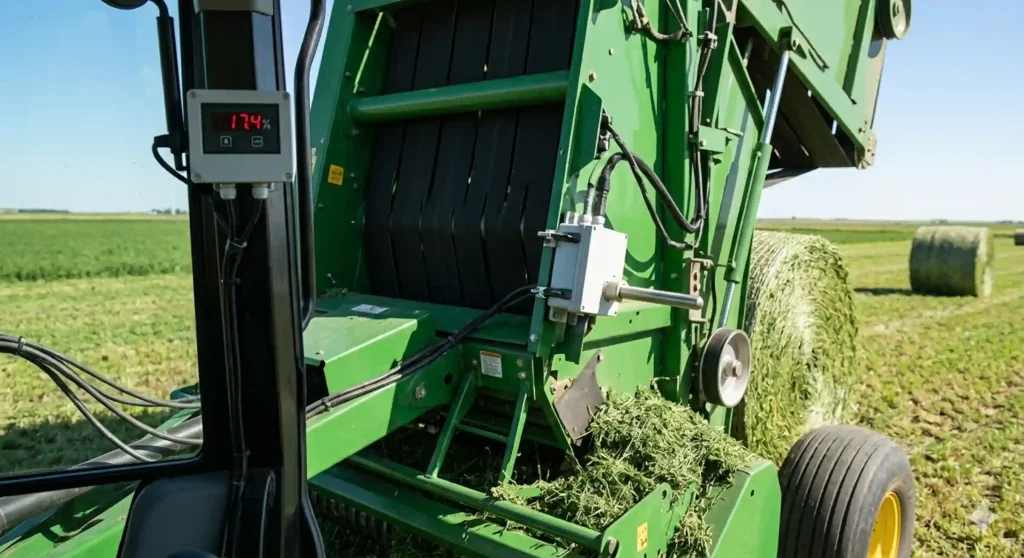
- Baler-mounted sensor: Built into modern commercial balers, continuously monitors moisture as hay enters the chamber. Some systems apply hay preservative automatically when readings exceed threshold.
- Microwave/oven drying: Lab-grade accuracy. Weigh a hay sample, dry for 60 minutes at 105°C, weigh again. Moisture content = (wet weight – dry weight) / wet weight × 100.
How a Proper Rake Affects Drying
Raking is not just about forming windrows—it’s a critical tool for moisture management. A fluffy, aerated windrow dries 30–50% faster than a dense, rope-like one. A rotary or belt rake produces much better-drying windrows than a wheel rake, because they preserve crop structure. If you’re consistently struggling with moisture management, the rake upstream of your baler may be the root cause. See our rake lineup in the 건초갈퀴 시리즈.
Hay Preservatives: A Moisture Safety Net
Propionic acid-based hay preservatives allow safe baling of hay at moistures 2–5% higher than normal. They work by inhibiting the molds and bacteria that cause heating. Preservatives are applied during baling, usually through an applicator mounted on the baler. Cost per bale is modest and can be offset by avoided weather-damage losses. Modern commercial balers often include preservative applicators as factory options—learn more about preservative-compatible balers in our 건초 압축기 시리즈.
What Happens If You Bale Too Wet
Hay baled above safe moisture undergoes a predictable sequence:
- Days 1–3: Bale temperature rises to 40–50°C (104–122°F). Minor yellowing may occur.
- Days 3–7: If temperature rises above 55°C (131°F), mold growth accelerates. Bale smells musty and sweet.
- Days 7–14: Temperatures above 65°C (150°F) produce caramel-colored “Maillard reaction” hay with reduced protein availability.
- Days 14+: Temperatures above 75°C (170°F) can trigger spontaneous combustion. Monitor bale stacks with probe thermometers for 6 weeks after baling wet hay.
Practical Field Tips for Moisture Management
- Morning vs afternoon baling: Mid-morning to early afternoon is typically the ideal baling window—hay has dried after dew evaporation but not become overly dry and brittle.
- Cloud cover awareness: Passing cloud cover can increase moisture 2–3% within an hour. Check moisture frequently during variable weather.
- Ground moisture migration: Swaths lying on damp ground pick up moisture from below. Rake early if bottom-of-windrow moisture is a concern.
- Species differences: Grass hays dry faster than legumes. Alfalfa and clover take 25–50% longer to reach baling moisture than grass hays under identical conditions.
Common Moisture Measurement Tools
Three main tools help operators verify moisture in the field: hand-held probe meters (push into a windrow, digital readout), bale-mounted moisture sensors (continuous readings during baling), and the time-tested “twist test” where you twist a handful of hay to feel for residual dampness. Professional operators usually combine at least two methods.
자주 묻는 질문
What happens if I bale at 25% moisture? Internal temperatures can reach 65–75°C within 3–10 days, causing mold and nutrient loss. Spontaneous combustion is possible at higher moistures. Do not stack or enclose such bales—monitor temperature daily if unavoidable.
Why do small bales tolerate higher moisture than large ones? Smaller bales have higher surface-area-to-volume ratios, allowing heat to dissipate and moisture to escape. A 40-lb mini round bale safely handles 22% moisture; a 1,500-lb large round requires 16–18%.
Hay Storage After Baling
Even correctly baled hay can spoil in storage if internal heat has nowhere to escape. Monitor bale temperature for the first 2–3 weeks after baling—internal temperatures above 60°C (140°F) indicate dangerous fermentation. Temperatures above 75°C (165°F) indicate imminent fire risk and require immediate action. Store bales with airflow between them for the first month, then consolidate tight storage once temperatures stabilize. Outdoor round bales should be spaced 3 feet apart on a well-drained surface, ideally oriented east-west to minimize weather exposure on the longest dimension.
Weather Window Planning
Successful hay producers plan cutting and baling around 5–7 day weather windows that provide consistent drying conditions. Modern weather forecasting, satellite moisture monitoring, and localized weather stations all support better decisions about when to cut. The best-laid plans still require operator judgment—sometimes cutting should be delayed for a day to avoid rain, and sometimes baling should begin at the edge of the moisture window because weather is deteriorating. Build decision-making routines around weather awareness to maximize hay quality year over year.
Recommended Related Product
📊 Baler-Mounted Moisture Sensor Kit: Continuously monitors incoming hay moisture during baling. LED display shows current reading and warns operator when moisture exceeds safe threshold. Fits most round and square balers via standard mounting. A must for commercial forage operations.
Source Professional Haymaking Equipment
Whether you’re producing dairy-grade alfalfa, commercial grass hay, or silage baleage, balancing moisture against bale type is the foundation of profitable forage. Balerhay supplies the complete chain—mowers, rakes, balers, and wrap equipment—engineered to work together.