
Understanding Hay Tedder Function in Modern Hay Production
Why the right tedding technique shaves a full day off curing time — and when skipping the tedder is the smarter call.
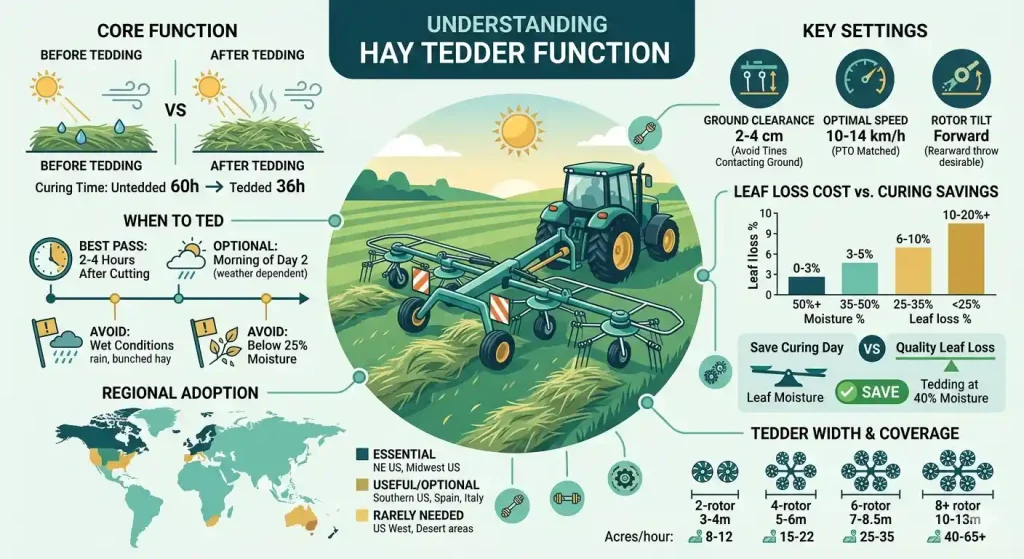
The tedder is often the most underrated piece of haymaking equipment. Sitting between the mower and the rake in the workflow, it’s responsible for accelerating the single slowest step in hay production: crop drying. A hay tedder functions by fluffing and spreading cut hay so more surface area contacts sun and wind, dramatically reducing dry-down time. On a good drying day, proper tedding can cut curing time from 60 hours to 36 hours — meaning you beat the next weather system with a day to spare. This guide explains what tedders do mechanically, when to use them, and how to operate them for best results.
What a Tedder Actually Does
A tedder consists of multiple rotors — typically 2, 4, 6, or 8 depending on machine width — each with a ring of spring tines that rotate horizontally. As the tractor pulls the tedder through the field, each rotor lifts cut hay off the ground, fluffs it by breaking up mats, and scatters it loosely across the swath width. The net effect is that hay that was sitting flat on the ground, shielding itself from the sun, gets flipped, fluffed, and exposed to drying conditions.
Modern tedders also shift hay sideways to help it relocate off damp ground onto drier ground where available. Some specialized models (usually called mergers rather than tedders) move hay more aggressively for specific downstream processes.
▸ Why Tedding Speeds Drying So Dramatically
Physics: water evaporates from hay surface at a rate proportional to exposed area and air exposure. Freshly-cut hay lying flat has relatively low exposed surface — the bottom of the swath sits on moist ground and never sees sunlight. Tedding lifts and fluffs, exposing essentially all the hay to sun and wind.
Real-world numbers: untedded alfalfa swath at 24 hours post-cut is typically 35–45% moisture. Tedded swath at 24 hours is 22–28% moisture. That’s a full day’s curing progress gained from a single tedding pass. In weather-critical situations where a storm is 48 hours away, this can be the difference between a saved crop and a rained-on one.
▸ When to Ted
Timing matters more than most operators realize. Key principles on when to ted hay:
- First tedding: 2–4 hours after cutting. Once the top of the swath has dried enough that leaves won’t shatter excessively, but the swath hasn’t started to crust on top. This first pass is the most valuable.
- Second tedding (if needed): morning of day 2. Only if weather is favorable and the crop is still above 30% moisture. Avoid tedding on high-humidity mornings before dew evaporates.
- Avoid tedding below 25% moisture. Once moisture drops this low, leaf shatter from mechanical handling exceeds the drying benefit. The math flips.
- Avoid tedding grass hay when leaves are brittle. Grasses without alfalfa are more leaf-resilient but even grass hay shatters below 20% moisture.
- Never ted in wet conditions. Wet hay bunches on the tines and doesn’t actually spread. Wait for the surface to dry before tedding.
▸ Tedder Types and How They Differ
Modern tedders come in two main flavors with meaningful differences:
- Rotary Tedder (most common). Multiple independent rotors rotating horizontally. Tines on each rotor lift, fluff, and scatter hay. Excellent performance across a wide range of crop conditions. Width options 3–12+ meters. The mainstream choice for commercial haymaking.
- Combined Rake-Tedder. Some compact implements perform both functions in a single pass — tedder mode for early curing, rake mode for final windrow formation. Good for small operations. Less optimized for either function than dedicated machines.
Tedders appear in our hay rake series alongside traditional wheel, rotary, and parallel-bar rakes — all sharing spring-tine designs but tuned for their specific forage-handling role.
▸ Setting Up the Tedder Correctly
A properly-set tedder fluffs and spreads hay without digging into the ground or damaging leaves. Critical settings:
- Ground clearance: Tines should contact the hay but not the ground. Typical setting: tines 2–4 cm above soil surface. Too high misses some hay; too low digs dirt into the crop.
- Rotor speed: Matched to forward speed. As a rule: ground speed around 10–14 km/h with PTO speed (typically 540 RPM) gives good performance. Slower ground speeds with higher rotor speeds over-handle; faster ground speeds under-handle.
- Rotor angle: Slight forward tilt (the front of the rotor lower than the rear) throws hay rearward and up, creating the fluffing action. Level or rearward tilt throws hay forward — generally undesirable.
- Tine condition: Bent, broken, or missing tines create bunching patterns and reduce tedding quality. Replace any damaged tines before starting the season.
▸ When Not to Ted
Tedding isn’t always beneficial. Skip the tedder when:
- Drying conditions are already excellent. In low-humidity, breezy conditions, untedded hay can reach baling moisture in 24 hours anyway. The marginal benefit of tedding doesn’t justify the fuel, labor, and leaf loss.
- Crop is already below 25% moisture. At this point, mechanical handling damage exceeds drying benefit.
- Very light crops. Thin stands produce thin swaths that don’t shield their own ground much to begin with — they dry well without intervention.
- Conditioned hay on short-dry schedules. A conditioner (steel or rubber rolls at the mower) already crushes the hay stems, accelerating drying. Extra tedding may be unnecessary.
- Haylage production. For silage/haylage, excessive drying is undesirable — target 45–60% moisture at baling. Tedding would overshoot that target.
▸ Leaf Loss: The Cost of Tedding
Tedding has a cost. Every pass of rotating tines through dried-out hay knocks off some percentage of leaves. For alfalfa, where leaves hold 65–70% of the protein, leaf loss directly translates to quality loss. Typical numbers:
- Tedding at 50%+ moisture: <3% leaf loss
- Tedding at 35–50% moisture: 3–5% leaf loss
- Tedding at 25–35% moisture: 6–10% leaf loss
- Tedding below 25% moisture: 10–20%+ leaf loss (avoid)
The math: one tedding pass at 40% moisture losing 4% of leaves saves a day of curing. If that saved day prevents rain damage or gets the crop into storage at 18% instead of 22% moisture, the tedding pays off 2–5× over. If conditions would have been fine anyway, the tedding was a net loss. Reading the weather and crop condition is how experienced operators make this call.
▸ Recommended Tedding Speed
Hay tedding speed (ground speed, not PTO speed) is one of the most impactful variables. Key principles:
- Too slow (<8 km/h): Rotors dwell in hay, over-handling leaves, causing excessive shatter
- Optimal (10–14 km/h): Tines contact hay for optimal fluffing time without over-handling
- Too fast (>15 km/h): Tines barely contact hay, poor fluffing, uneven spread
Many operators run too slow, thinking slower = more thorough. In fact, tedding is one of the few agricultural operations where moderate speed produces better results than slow speed.
▸ Maintenance
Pre-season: inspect all tines, replace damaged ones (tines are consumables, 500–1,500 hour service life depending on soil abrasiveness). Grease rotor bearings. Check PTO shaft universal joints and slip clutch. Check ground-following wheels for proper tire pressure and bearing condition.
In-season: daily tine inspection, weekly bearing grease, monthly PTO driveline inspection. Replacement tines, driveline components, and bearings for major tedder brands are stocked in our other product series.
Regional Adoption: Where Tedders Are Essential vs Optional
Understanding hay tedder function in context means also knowing where the machine earns its keep vs where it can be skipped:
- Essential regions: Northeast US, Midwest US, eastern Canada, UK, Ireland, northern Germany, Netherlands, northern France, New Zealand. Variable weather and compressed drying windows make tedding almost mandatory for reliable quality.
- Useful-but-optional regions: Southern US, Spain, southern France, Italy, Australia interior. Good drying conditions reduce the tedder’s marginal benefit, but the machine still helps in above-average-humidity years.
- Rarely needed regions: US West (Arizona, Nevada, Idaho, eastern Oregon), Saudi Arabia, UAE irrigated-desert hay production. Dry climate delivers hay to baling moisture in 24–36 hours without intervention.
Tedder Working Width and Coverage Economics
Tedder working width drives productivity. Common width classes:
- 3–4 m (2-rotor): Compact class, 30–40 HP tractor. Covers 8–12 acres/hour.
- 5–6 m (4-rotor): Mid-range, 45–65 HP tractor. Covers 15–22 acres/hour. Mainstream commercial choice.
- 7–8.5 m (6-rotor): Large-farm class, 65–95 HP tractor. Covers 25–35 acres/hour.
- 10–13 m (8+ rotor): Professional custom operators. Covers 40–65 acres/hour. Folds for transport to <3 m width.
For operations where weather windows are the limiting factor, one size up from your “just right” width pays for itself in faster coverage when timing matters.
Recommended Companion Product
Tedder Spring Tines (Heavy-Duty) — Spring-steel replacement tines for major rotary-tedder brands. Heat-treated for fatigue resistance, sold in 10-tine, 20-tine, and full-set packs. OEM-equivalent dimensions; 35–45% below branded-replacement pricing.
Ted Faster, Cure Cleaner, Bale on Schedule
From replacement tines to complete tedder packages — gear up for every drying window.