Silage vs Haylage vs Dry Hay: Which Forage Production Method Is Right for You?
The same standing crop — a field of alfalfa, grass, or mixed forage — can be harvested three fundamentally different ways: as dry hay, as haylage, or as silage. Each method has distinct equipment requirements, weather sensitivity, storage demands, nutritional profiles, and market applications. The silage vs haylage vs dry hay decision isn’t one-size-fits-all — it depends on climate, herd type, storage infrastructure, labor availability, and end-market. This guide breaks down each method side-by-side so you can make an informed production choice for your specific operation.
Quick Definitions
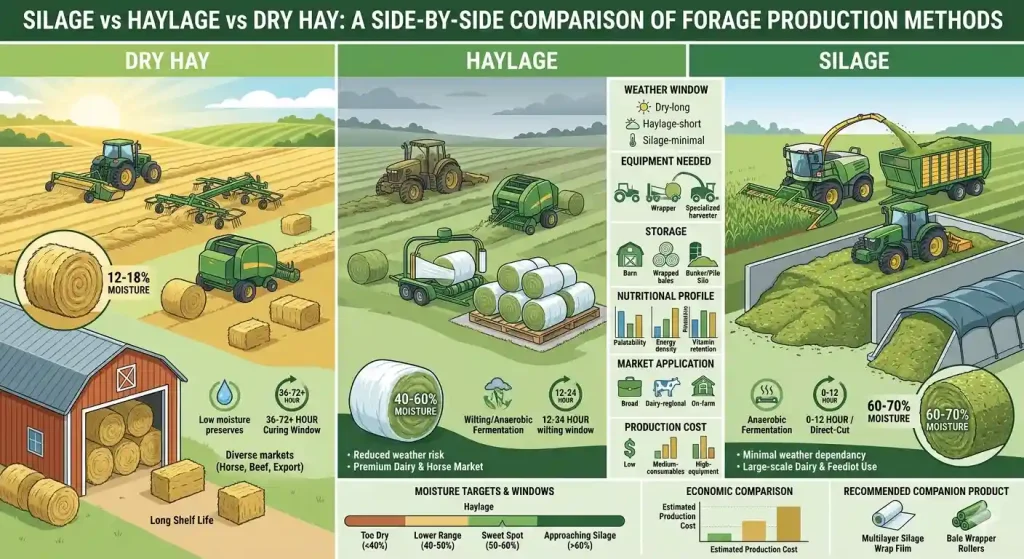
DRY HAY
Moisture at storage: 12–18%
Preservation mechanism: Low moisture prevents microbial activity
Curing time in field: 36–72 hours after cutting
HAYLAGE (Wrapped Bale Silage)
Moisture at storage: 40–60%
Preservation mechanism: Anaerobic fermentation in sealed wrap
Curing time in field: 12–24 hours after cutting
SILAGE (Chopped, Bunker/Pile/Silo)
Moisture at storage: 60–70%
Preservation mechanism: Anaerobic fermentation under compaction
Curing time in field: 0–12 hours (often direct-cut)
The Weather Window Difference
The most important practical distinction: how much good weather each method requires.
- Dry hay: Needs 3+ consecutive days of good drying weather. In regions with variable summer weather (Northeastern US, UK, Ireland, northern Germany), getting a 3-day window can be rare — causing repeated quality losses to rain damage.
- Haylage: Needs only 12–24 hours of partial drying. Light rain during wilting is tolerable. Dramatically reduces weather risk in marginal-climate regions.
- Silage: In direct-cut systems, no drying needed at all. Cut, chop, store same day. Minimal weather dependency.
For producers in wet climates, this alone often drives the choice toward wrapped bale silage or conventional silage. Getting consistent quality from dry hay in climates with <4-day good windows is fundamentally difficult.
Equipment Requirements by Method
Each method has distinct equipment needs:
- Dry hay: Mower-conditioner, tedder (optional but recommended), rake, dry-hay baler (round or square), storage (barn/tarp), hay handling (loader, wagon). Initial investment: $80,000–250,000 for a commercial-scale operation.
- Haylage: Mower-conditioner, rake (no tedder needed — wilting is minimal), baler (round or small square), bale wrapper, storage (stacked wrapped bales on pallet pad). Initial investment: $120,000–300,000 — bale wrapper is the added expense.
- Silage: Forage harvester (self-propelled or pull-type), silage wagons, bunker silo or silo bags, silage handling equipment. Initial investment: $200,000–800,000+ at commercial scale. Scale economics make silage appropriate mostly for 500+ acre operations.
Storage and Handling Differences
Post-harvest storage and handling also differ significantly:
- Dry hay storage: Barn, shed, or tarped outdoor. Long shelf life (12–24+ months). Easy to handle, transport, and sell into broad markets. Weather-resistant once stored properly.
- Haylage storage: Wrapped bales stacked on pallet pad. Shelf life 6–18 months (wrap integrity limited). Heavy bales (800–1,200 kg) require larger loader capacity. Once wrap is punctured, bale spoils within days.
- Silage storage: Bunker silo, tower silo, or silo bag. Long-term storage only if anaerobic conditions maintained. Once opened, face must be fed within 1–2 days per section to prevent spoilage at exposed face.
Nutritional Profile Differences
The three methods yield meaningfully different nutritional profiles from the same standing crop:
- Dry hay: Lower energy density (water removed), lower palatability vs fermented forages, lower vitamin A (degrades in sun curing), but high NDF digestibility if well-made. Standard protein and fiber per dry matter.
- Haylage: Higher palatability, higher energy density (organic acids from fermentation), better vitamin retention, slightly reduced protein quality (fermentation loss). Cows often eat haylage more readily than dry hay.
- Silage: Highest moisture content means high palatability and dense energy intake. However nutrient content per dry matter is generally equivalent to haylage. Main advantage is feed intake rate — cows consume more silage per meal than dry hay.
Market Application
Each forage type serves different market niches:
- Dry hay: Broad markets — dairy, beef, horse, small ruminant, export. Sellable to end-users hundreds of miles away. Transport economics favor dry hay for long-distance sales.
- Haylage: Primarily dairy (especially high-producing dairy) and some premium horse markets. Heavier transport cost per dry-matter unit limits distant sales. Mostly sold regionally within 50–100 km.
- Silage: Almost exclusively fed on-farm or sold to neighboring dairy operations. Not a commodity market — essentially always custom-arranged sales.
Moisture Targets and Windows
Precise haylage moisture targeting is critical for successful fermentation:
- Below 40%: Too dry for reliable fermentation. Risk of mold growth in poorly-sealed bales. Treat as dry hay instead.
- 40–50%: Lower end of haylage range. Good fermentation possible but higher risk of mold if wrap is damaged.
- 50–60%: Sweet spot for haylage. Reliable fermentation, manageable bale weight.
- Above 60%: Approaching silage territory. Bales get heavy (>1,200 kg), handling difficult, risk of effluent (fermentation liquid) escape.
Which Should You Choose?
A decision framework:
- Choose dry hay if: Your climate has reliable 3-day good windows, you sell into diverse markets beyond dairy, you need long shelf life, you want simple storage, or you operate at scales below 200 acres.
- Choose haylage if: You’re in a marginal-weather climate, you feed your own dairy or premium-horse livestock, you want reduced weather risk, or you have between 100–500 acres to harvest.
- Choose silage if: You feed 200+ head dairy on-farm, you have scale for chopper equipment and silo infrastructure, or you’re in a region where silage dominates local dairy (northeastern US, northern Europe, New Zealand pasture operations).
- Many operations run 2 methods: dry hay for commercial sales plus silage for on-farm dairy use, for example.
Hybrid and Adaptive Operations
Experienced operators adapt method to conditions. In a cutting with favorable weather: dry hay. In a cutting with marginal weather: haylage. In a cutting with worse weather: silage (if equipment is available). This adaptive approach maximizes quality recovery across variable seasons but requires investment in both baling and wrapping equipment, plus potentially silage-chopping capability.
For operations primarily doing dry hay but wanting haylage backup for bad-weather windows, adding a bale wrapper to an existing baler fleet is the most capital-efficient move — typically $30,000–60,000 for a commercial bale wrapper. Combined with existing mower-conditioner and baler, this unlocks haylage production without a full equipment overhaul.
Regardless of which forage preservation methods you choose, reliable driveline components (PTO shafts, gearboxes, slip clutches) keep the equipment running through the compressed harvest windows each method demands. Our other product series stocks driveline parts and bale wrap materials for multiple haymaking methods.
Rake and Merging Considerations
All three methods benefit from proper windrow formation before baling or chopping. For dry hay, uniform windrows feed the baler consistently. For haylage, tighter windrows maintain higher density for better fermentation. For silage, specialized mergers combine multiple swaths into one large windrow for efficient forage-harvester intake. Our hay rake series covers the rake designs relevant for dry hay and haylage; dedicated mergers are specified through our sales team for silage operations.
Economic Comparison: Dollars per Ton Produced
Beyond qualitative differences, the silage vs haylage vs dry hay choice has quantitative economic implications. Rough per-ton cost comparison (production cost, not sale price):
- Dry hay: $85–130/ton dry-matter production cost. Low ongoing consumables (just net wrap or twine). Simple equipment. Lowest per-ton cost when weather cooperates.
- Haylage: $105–160/ton dry-matter production cost. Significant wrap-film cost ($25–45/bale). Faster production with less weather risk offsets consumable expense.
- Silage: $115–180/ton dry-matter production cost. Highest equipment and storage capital investment. Lowest per-ton cost at very high volume (1,000+ ton operations).
These are production cost estimates, not sale prices. Sale prices vary by market: dry hay $180–380/ton (wide quality spread); haylage $160–260/ton (narrower market); silage typically not sold commercially.
Transitioning Between Methods
Operations often transition from one method to another as circumstances change. Common transitions:
- Dry hay → haylage when weather reliability decreases or labor availability drops (haylage requires less time in the field)
- Dry hay → silage when growing a dairy herd that can consume all production on-farm
- Silage → haylage when reducing herd size but keeping the forage operation
- Adding haylage alongside dry hay — hedging against weather variability while retaining dry-hay market access
Recommended Companion Product
Silage Wrap Film / Bale Wrapper Rollers — Multilayer co-extruded silage wrap film for wrapped-bale haylage (6-layer and 8-layer options). Also: replacement wrapper rollers and cutting blades for major bale-wrapper brands. UV-stabilized for extended outdoor storage.
Choose the Right Forage Method — Then Gear Up Properly
Whether dry hay, haylage, or silage — we supply the equipment, wrap materials, and replacement parts that keep production running.