Sourcing Hay Balers from Manufacturers: A B2B Buyer’s Guide for Dealers & Distributors
If you’re a dealer, distributor, or large-volume procurement buyer looking to expand your agricultural machinery portfolio, sourcing hay balers from the right hay baler manufacturer can be the difference between a profitable product line and a service nightmare. The global baler market has dozens of brands spanning every price tier, and the differences between them—especially once you move beyond the big-name OEMs—are harder to evaluate than marketing materials suggest. This guide shares what experienced dealers actually check before committing.
Why Manufacturer Selection Matters for Dealers
Unlike consumer products, agricultural machinery has a long warranty tail. A round baler you sell today will likely be in service 10 years from now, and your dealership’s reputation depends on parts availability and technical support over that entire decade. A manufacturer with great pricing but poor after-sales support will destroy customer relationships faster than any price-based advantage can build them. The stakes are even higher for distributors reselling to multiple dealers—your credibility is on every single baler that enters the market under your logistics chain.
Tier 1 OEM vs Contract Manufacturer: Key Differences
The global baler market splits into roughly three supplier tiers:
- Tier 1 OEM brands: John Deere, New Holland, Vermeer, Kuhn, Case IH, Massey Ferguson, Krone, Claas. These established brands command premium pricing but deliver mature engineering, global dealer networks, and brand equity that sells itself.
- Specialist manufacturers: Freeman, Pronar, Maschio Gaspardo, Abbriata, Takakita, Takura. Strong in specific segments (small square balers, mini rounds, specialty crops) with dedicated expertise.
- ODM/OEM contract manufacturers: Produce to specification for private-label customers. Quality ranges widely—due diligence is essential.
For dealers looking to differentiate from Tier 1 competitors on price without sacrificing reliability, the specialist and ODM tiers offer the strongest opportunity—provided you select your manufacturer carefully.
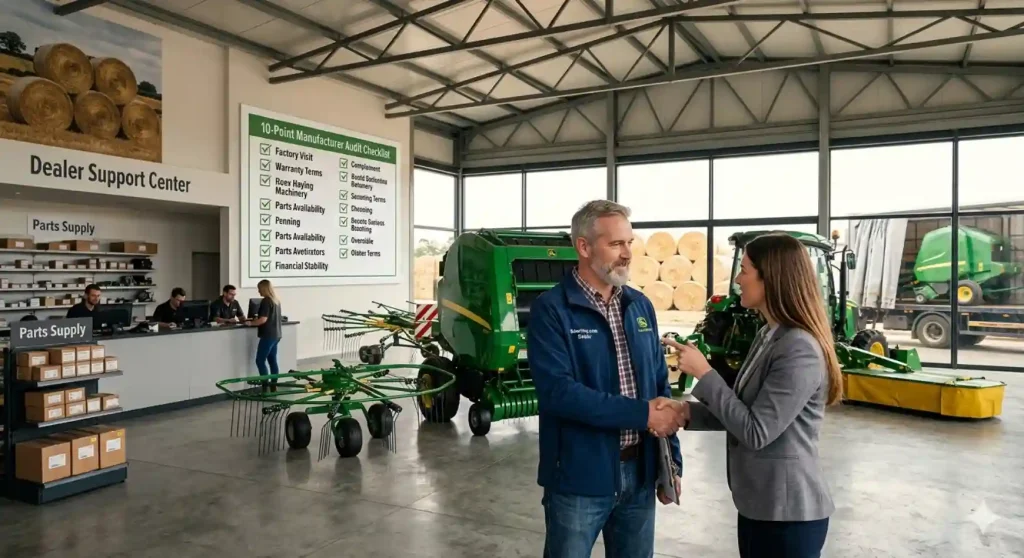
The 10-Point Manufacturer Audit Checklist
Before placing a container-load order with any new hay baler supplier, work through this audit:
- 1. Factory visit or video audit: See the actual production floor, not marketing photos. Verify scale matches stated capacity.
- 2. Quality certifications: ISO 9001 at minimum; CE marking for Europe-bound product; EPA certifications for North American markets.
- 3. Reference customers in your target market: Ask for existing dealer references and call them. Ask specifically about warranty claim resolution speed.
- 4. Parts availability and lead times: Verify stocked wear parts, common gearbox replacements, and critical components. 30-day lead time is the maximum acceptable for routine parts.
- 5. Engineering capability: Can they modify specifications for your market (metric vs imperial, PTO speed, hitch type)?
- 6. Warranty terms: Minimum 12 months full coverage; look for 24 months on gearboxes and major castings.
- 7. Technical support response time: Test their support team with a detailed technical question before ordering. Response within 24 hours is expected.
- 8. Manufacturing consistency: Review serial-numbered batch records. Good manufacturers track every machine through QC.
- 9. Financial stability: Verify the supplier isn’t about to disappear. Check business registration age, employee count, annual revenue if disclosed.
- 10. Export experience: Ask which countries they currently ship to. A supplier with no existing North American or European export experience will likely have documentation issues.
OEM / ODM Considerations for Private Label
Many dealers and distributors source balers under their own brand for retail. When evaluating an OEM hay baler manufacturer for private-label work:
- Minimum order quantity: Typical MOQs for private label start at 10 units; dedicated color/branding may require 20–50.
- Customization options: Can you specify your own paint color, decals, manual covers, serial number format?
- Exclusivity: Can you lock in a model or territory exclusivity clause?
- Gradual volume ramp: First order might be smaller than the nominal MOQ if the relationship develops well over time.
- Documentation transfer: Operator manuals, service manuals, and warranty documents in your target language.
Logistics & Shipping Considerations
Balers are large, heavy, and awkwardly shaped—shipping economics matter. A single 40-ft container holds 3–6 round balers depending on size and packaging. Key considerations:
- Incoterms: FOB (free on board) is standard for most buyers; CIF (cost, insurance, freight) simplifies first-time orders but costs more.
- Packaging standards: Verify balers are shipped with adequate blocking, waterproof covers, and desiccant in electronics.
- Marine cargo insurance: Don’t skip this. Balers can be damaged in rough seas if not properly secured.
- Customs documentation: HS codes, certificates of origin, phytosanitary certificates if required.
Bulk Purchase Pricing Structures
For wholesale hay balers, price breaks typically apply at 10, 20, 50, and 100 units. Beyond volume, pricing improvements come from:
- Annual volume commitments with staged shipment
- Standardized specifications (avoiding custom options reduces production cost)
- Longer lead times (accept 60-day ship vs 30-day)
- LC (letter of credit) payment terms
- Combined orders for balers + rakes + parts (consolidating purchasing volume)
Building a Full Equipment Line
Smart dealers don’t sell just balers—they sell complete haymaking solutions. The most successful dealers offer customers coordinated packages: mower + rake + baler + handling equipment, with unified service support. Sourcing from a manufacturer who offers the full lineup under one roof simplifies procurement, inventory, parts training, and warranty coordination. Explore our complete equipment portfolio at Шөп жинаушы сериясы—we also supply rakes and mowers designed to work seamlessly together.
Don’t Forget the Parts Business
The real long-term profit in the baler business is spare parts. A baler sells once; it consumes pickup tines, belts, chains, twine, net wrap, bearings, and drivelines for 10+ years. Establish a strong parts supply relationship from day one, and factor parts margin into your overall dealer economics. Our organized parts catalog for dealers is available in the Басқа өнімдер сериясы.
Red Flags to Watch For
- Pricing that seems far below market—something is being compromised on quality
- Vague or evasive answers to technical questions
- Reluctance to provide factory photos, video tours, or references
- No clear warranty process or who handles claims
- Very short lead times that seem too good to be true (could indicate shelf inventory of unsold rejects)
- Inconsistent branding across product and documentation
Dealer Success Factors Beyond the Manufacturer
Even the best manufacturer can’t overcome weak dealer execution. Successful dealers invest in: trained service technicians (hire, train, and retain them), dedicated parts inventory (USD 20,000+ in stocked inventory for a new hay equipment line), marketing materials in local languages, customer financing partnerships, and trade-in program support. Manufacturers that support all these areas are worth a modest price premium over bare-bones suppliers.
Жиі қойылатын сұрақтар
What’s a realistic first-year sales target for a new hay baler dealer? Depends on market size and competition, but 10–30 units in Year 1 is typical for a new dealer in a region with existing hay production. Targets should grow 20–40% annually as brand recognition builds.
How important is factory training for my service team? Essential. Factory-trained technicians solve problems 3–5× faster than self-taught ones, reducing customer downtime and warranty claim costs. Good manufacturers offer annual training programs, service videos, and direct technical hotlines.
Should I represent multiple baler brands? Generally no for established markets—focus on one primary brand for depth of expertise. In emerging markets or dealer networks serving diverse customer segments, carrying two complementary brands (one premium, one value) can work if service capacity permits.
How do I verify my manufacturer’s quality before placing a large order? Request a sample shipment of 1–2 units before committing to container volumes. Use the samples for 3–6 months in typical customer conditions before scaling up.
Payment Terms & Risk Mitigation
For first-time orders with new manufacturers, established payment protections are essential. Standard practices include: 30% deposit / 70% balance against shipping documents (T/T); irrevocable letter of credit (L/C) at sight for larger orders; third-party inspection at factory before shipment (SGS, BV, or Intertek); and escrow services for initial transactions under USD 50,000. Never pay 100% in advance for a first-time supplier relationship. Established relationships may migrate to more favorable terms (60 days net, open account) once trust and track record are established.
Recommended Related Product
📋 Dealer Starter Package: Curated entry-level inventory for new dealers, including: 3× mini round baler units, 2× hay rake units, PTO shaft selection (6 common sizes), common wear parts for full warranty support (12-month coverage), and marketing materials. Designed to minimize setup complexity for dealers entering the hay equipment category.
Partner with a Manufacturer Built for Export
Balerhay has supported dealers and distributors across 40+ countries with round balers, hay rakes, lawn mowers, and parts. Our export-focused operation includes multilingual technical support, regionally-adapted certifications, and a dedicated dealer success team. We welcome inquiries from established dealers looking to expand their agricultural machinery portfolio, and from new entrants entering the hay equipment category.
editor:WM