
Hay Baler Troubleshooting Guide: Diagnose 10 Common Problems Fast
When a baler stops mid-field with a storm rolling in, you don’t have time to read an entire service manual. You need to know what’s wrong, why it’s wrong, and how to fix it—fast. This hay baler troubleshooting guide covers the 10 most common problems experienced baler operators encounter, with the diagnostic logic and proven fixes. Bookmark this page or print it and keep it in your tractor cab.
Problem 1: Baler Won’t Pick Up the Windrow Cleanly
Symptoms: Hay visibly left on the ground, uneven pickup, or the baler skipping hay entirely.
Likely causes:
- Missing or broken pickup tines (most common)
- Pickup height set too high
- Ground speed too fast for windrow density
- Pickup gauge wheels set wrong
- Windrow is too wide for pickup width
Fix: Stop and inspect the pickup visually. Replace missing tines. Lower pickup 1–2 cm at a time until it clears hay cleanly. Reduce ground speed by 1–2 mph. Adjust windrow width at the rake.
Problem 2: Bales Are Barrel-Shaped (Bigger in Middle)
Symptoms: Round bales bulge in the middle; square bales have uneven flakes.
Likely causes:
- Windrow too narrow (all hay feeding to center)
- Operator driving straight down every windrow instead of weaving
- Pickup running unevenly (tines worn on one side)
Fix: Widen windrows using a wider-spread rake setting. Weave the tractor slightly side-to-side as you follow the windrow to distribute hay across the pickup width. Replace uneven tines.
Problem 3: Bales Are Lopsided (Bigger on One End)
Symptoms: Round bales have distinct heavy side; square bales are fatter on one end.
Likely causes:
- Driver consistently running on one side of the windrow
- Asymmetric pickup problems (one side plugging)
- Belt tension uneven (variable chamber)
- Roller alignment issues (fixed chamber)
Fix: Make a conscious effort to center windrows under the pickup. Inspect the pickup for one-sided debris or damage. Check and equalize belt tension on both sides. Align rollers if a fixed-chamber baler.
Problem 4: Baler Is Plugging (Hay Jamming in Rotor)
Symptoms: Baler stops feeding; chamber door opens to reveal a massive plug of hay.
Likely causes:
- Ground speed too fast
- Windrow too heavy for baler capacity
- Hay is too wet
- PTO speed too low
- Rotor knives dull or missing (on cutter-equipped balers)
Fix: Reduce ground speed immediately. Clear the plug by reversing rotor direction if your baler has that feature. Verify PTO is at 540 RPM, not lower. Check and sharpen rotor knives. Wait longer between cutting and baling if hay is wet.
Problem 5: Twine Breaks Repeatedly
Likely causes: Twine tension too tight; twine feed path rubbing against sharp edge; twine is old or of poor quality; baler is forming too-dense bales for the twine strength.
Fix: Reduce twine tension. Inspect feed path for burrs or sharp edges—file smooth. Use fresh, quality twine rated for your bale density. Reduce chamber pressure slightly.
Problem 6: Round Baler Won’t Tie (No Wrap Starts)
Likely causes: Bale hasn’t reached density sensor threshold; twine arm or net arm mechanism jammed; sensor or switch malfunction; hydraulic pressure low for tie cylinders.
Fix: Verify bale is fully formed—sometimes lightweight dry hay doesn’t trigger density sensors. Manually cycle the twine or net mechanism to locate binding. Check electrical connections to sensors. Confirm hydraulic oil level.
Problem 7: Square Baler Missing Knots
Square baler knotters are precision devices with specific timing requirements. Symptoms of knotter problems include: loose bales with trailing twine, bales with only one of two strings tied, or complete failure to tie.
Common causes and fixes:
- Needle timing off—refer to service manual; resetting is a specialist job for most operators.
- Billhook worn or broken—replace with factory part.
- Twine disc worn—replace.
- Knife dull or broken—replace.
- Twine path dirty or corroded—clean with solvent and light oil.
Problem 8: Net Wrap Torn or Uneven
Likely causes: Net roll not loaded correctly; net tension too high; duckbill jaws worn or dirty; chamber speed too fast during wrap cycle.
Fix: Verify net roll is seated properly and feeding straight. Reduce net tension to recommended setting. Clean the duckbill or gripper assembly. Verify chamber speed drops correctly at wrap initiation.
Problem 9: Excessive Vibration
New vibration is always a warning sign. Common causes include: bent or damaged PTO shaft, bearing failure in a rotating component, belt failure, loose fasteners on rotating components, or unbalanced chamber roller.
Fix: Stop operation and investigate. Running with vibration damages bearings, gearboxes, and frames—the repair cost grows exponentially the longer you ignore it. Spare bearings and drive components are available in our その他の製品シリーズ.
Problem 10: Gearbox Overheating or Leaking
Likely causes: Low or wrong oil; overload from attempted too-dense bales; seal failure from contamination; bearing failure starting a chain reaction of damage.
Fix: Stop immediately—continued operation destroys the gearbox. Check oil level and condition. If oil is black or smells burnt, the gearbox is damaged and must be serviced. If oil is low with visible external leak, replace seals. Running a gearbox low on oil even for 30 minutes can scrap it.
When DIY Stops Working: Call for Support
Most baler problems fall into the categories above and can be solved in the field. But some require specialist intervention: knotter timing, gearbox rebuilds, hydraulic pump failures, or electronic monitor issues. Our technical support team is available by phone and email during peak hay seasons globally, with multilingual support for dealer partners. For parts needs, the full 干し草ベーラーシリーズ product pages include detailed service videos and diagnostic flowcharts.
Diagnostic Decision Tree: Start Here
When the baler acts up, follow this systematic approach:
- Step 1: Is it a pickup problem (hay left on ground)? Check tines, pickup height, ground speed.
- Step 2: Is it a feeding problem (plug, jam, stoppage)? Check PTO speed, ground speed, moisture.
- Step 3: Is it a forming problem (bad shape, wrong size)? Check windrow, driving pattern, belts or rollers.
- Step 4: Is it a tying/wrapping problem? Check twine/net feed path, timing, sensors.
- Step 5: Is it a mechanical noise or vibration? Stop immediately and diagnose before further damage.
Field Repair Priorities
Some problems can be fixed in the field in 5 minutes; others require the baler to come out of the field. Quick field fixes include: tine replacement, shear bolt replacement, chain repair with master links, twine reload, plug clearing, and pickup height adjustment. Shop-required repairs include: gearbox problems, hydraulic system failures, electrical/sensor issues, knotter timing, and bearing replacement on major components.
よくある質問
My baler was working fine yesterday but won’t feed today. What’s wrong? Most common cause: hay moisture changed overnight. Check moisture content—damp hay from morning dew or rain feeds poorly. Wait for drying, or reduce ground speed dramatically.
How can I prevent plugging in heavy crops? Reduce ground speed, run at full PTO speed (540 RPM), use wider windrows (less density), and ensure rotor knives are sharp. Heavy crops may simply exceed baler capacity—some conditions require accepting lower field speed.
Building a Field Repair Toolkit
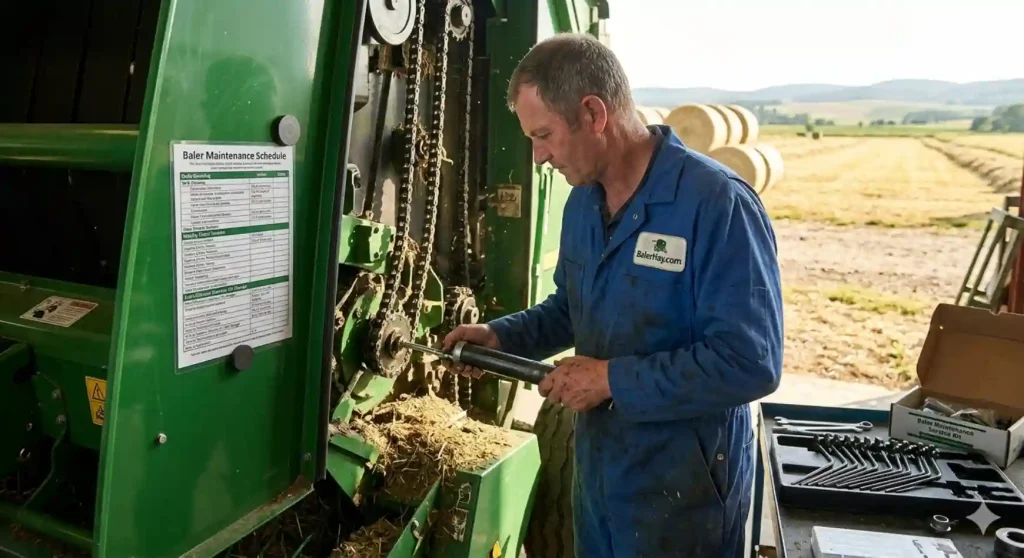
Every baler should have a dedicated field repair kit carried in the tractor during operation. At minimum include: a complete set of common wrenches (both metric and imperial if running mixed equipment), hammer and punch set, side cutters, pliers, screwdriver set, flashlight, work gloves, tie-wire, and electrical tape. Add consumables specific to your baler: spare tines (at least 6), shear bolts in common sizes, chain master links, twine/net wrap spool, and a grease gun with fresh cartridge. This kit pays for itself the first time you fix a breakdown in 20 minutes instead of driving back to the shop.
Recommended Related Product
🆘 Emergency Baler Repair Kit: Field-repair-ready kit with the most-broken parts during peak season: pickup tines (12 pcs), shear bolts (assorted 10 pcs), chain master links, twine spool, net wrap emergency section, and compact tool roll with drift punch, adjustable wrench, and grease gun. Fits under the tractor seat.
Get Back in the Field Faster
Every minute of baler downtime during peak season is lost revenue. Balerhay’s rapid-response parts inventory, combined with direct-to-farm shipping, gets you back in operation as quickly as possible. Contact our support team for emergency parts or technical assistance.