Small Farm Hay Equipment Package: Starter Kit Recommendations for Under-100-Acre Operations
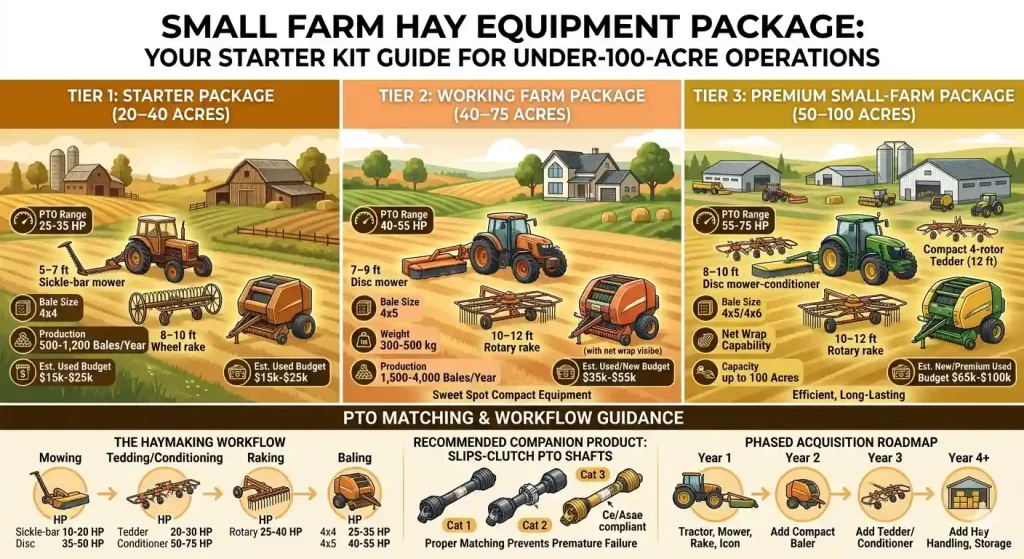
For farms managing 20 to 100 acres of hay, equipment choices differ dramatically from commercial-scale operations. Full-size haying equipment is overkill — expensive, power-hungry, and matched to acreage you don’t have. At the other extreme, consumer-grade garden-tractor implements are too flimsy for real hay production. The sweet spot is purpose-built small farm hay equipment — compact, matched to 35–75 HP tractors, durable enough for annual use, affordable enough to pencil out on small-acreage economics. This guide walks through the three practical equipment tiers for small-farm hay production and what each costs to put together.
The Basic Haying Workflow
Every hay production operation needs 4 core equipment functions:
- Mowing: Cut the standing crop
- Tedding/Conditioning: Accelerate drying (optional at smallest scales)
- Raking: Form windrows for the baler
- Baling: Package into bales for storage and handling
Additional functions — hay handling (loader, wagon), storage (barn, tarp), and optional conditioning — complete the workflow. For small farms, the budget usually supports minimum-viable coverage of the four core functions, with added items phased in over multiple seasons.
Tier 1: Starter Package (20–40 acres, $15,000–25,000 used)
Entry Tier — The Minimum-Viable Hay Kit
- Tractor: 35–45 HP (if not already owned), used $8,000–15,000
- Sickle-bar mower (5–7 ft): Used $1,200–2,500. Lower-horsepower requirement than disc mowers.
- Wheel rake (8–10 ft): Used $1,500–3,000. PTO-driven or ground-driven depending on model.
- Compact round baler (4×4 bale size) or small square baler: Used $6,000–12,000. Compact/mini round balers ideal for small farms.
Approach: buy used, buy older reliable models, accept longer cycle times and manual labor. Suitable for hobby farm baler operations producing 500–1,200 bales per year for own-use or small-scale direct sale. Not suitable for commercial haymaking above 50 acres.
Tier 2: Working Farm Package (40–75 acres, $35,000–55,000)
Working Tier — Efficient Mid-Range Kit
- Tractor: 50–65 HP (standard agricultural tractor size), used $15,000–25,000
- Disc mower (7–9 ft): Used $5,000–12,000, or new economy $12,000–18,000
- Rotary or wheel rake (10–12 ft): Used $3,000–6,000, or new $6,000–10,000
- Compact round baler (4×5 bale size): Used $12,000–20,000, or new economy $18,000–28,000
This is the compact hay equipment sweet spot. The disc mower cuts faster than sickle-bar, rotary rake handles variable windrows better than wheel rake, and compact round balers produce storable 4×5 bales (300–500 kg each) that can be handled with a loader tractor. Production capacity: 1,500–4,000 bales per year. Suitable for small commercial sales and on-farm livestock feeding.
Tier 3: Premium Small-Farm Package (50–100 acres, $65,000–100,000)
Premium Tier — Efficient, Capable, Long-Lasting
- Tractor: 65–85 HP (standard ag tractor), new economy $35,000–50,000 or used premium $20,000–35,000
- Disc mower-conditioner (8–10 ft): New $18,000–28,000. Integrated conditioning accelerates drying by 30%.
- Compact tedder (optional, 4-rotor 12 ft): New $6,000–10,000. Cuts drying time further on marginal weather days.
- Rotary rake (10–12 ft): New $8,000–14,000. Best windrow formation for consistent baling.
- Compact round baler (4×5 or 4×6): New $25,000–40,000. Net wrap capable, newer control systems.
Premium tier equipment handles 100 acres comfortably, sometimes allows small acreage haying with some custom-work income. Equipment life 15–20+ years with proper maintenance. Appropriate for serious hobby farms, small commercial operations, and producers who want best-quality tools despite small acreage.
Budget Tradeoffs: New vs Used
For small-farm budgets, the new-vs-used decision matters most for each category:
- Tractor: Used is usually the right call. Agricultural tractors depreciate heavily in years 1–8 but run reliably for 30+ years with maintenance. A 10-year-old 65 HP tractor with 2,500 hours is typically worth 40–50% of new price and has 80% of its useful life remaining.
- Baler: Mid-ground. Older balers (20+ years) work but have compounding issues with worn belts, gearbox, chamber bearings. Buy used up to 10 years old; consider new for longer time horizon.
- Mower-conditioner: Newer is better. Conditioner rolls wear significantly after 10 years, and replacement cost often exceeds the value of older machines.
- Rake: Used is fine. Rakes have few wear items — tines, bearings, and PTO shaft are replaceable. Older rakes work as well as newer ones at a fraction of the cost.
- Tedder: Used is fine, similar to rake.
PTO and Power Matching
A common mistake in small-farm equipment selection is mismatching tractor PTO capacity to implement requirements. Typical PTO horsepower requirements:
- Compact round baler (4×4): 25–35 PTO HP
- Compact round baler (4×5): 40–55 PTO HP
- Compact round baler (4×6): 55–75 PTO HP
- Small disc mower (7–8 ft): 35–50 PTO HP
- Disc mower-conditioner (8–10 ft): 50–75 PTO HP
- Rotary rake (10–12 ft): 25–40 PTO HP
- Tedder (4-rotor 12 ft): 20–30 PTO HP
For a complete small-farm haying setup, a 55–65 HP PTO tractor covers all the core implements with margin. Under-powered tractors (e.g., attempting 4×5 round baling with a 35 HP tractor) produces soft-core bales, slow operation, driveline stress, and premature baler failures. Proper PTO shafts matched to the driveline rating are critical — an undersized PTO shaft is the fastest way to fail components. See our other product series for properly-rated PTO shafts sized for small-farm implements.
The Cut-Skip Option
For the smallest operations (under 30 acres), a common practical approach is: own mower, rake, and tractor; hire out the baling to a custom operator. This works because: (1) mowing and raking are time-flexible operations that can be done on your own schedule, while (2) baling is time-critical and equipment-intensive. Custom baling rates in 2026 run $15–25 per round bale, meaning a 30-acre farm producing 200 bales pays $3,000–5,000 annually for custom baling — often less than the annualized cost of owning a baler.
This approach works well until acreage grows past 60–80 acres, at which point custom baling costs justify owning a baler.
Lawn Mower vs Sickle/Disc Mower
A note on mower selection: finish mowers, flail mowers, and brush-hog rotary mowers are optimized for landscape or pasture-clip applications, not for haymaking. True hay mowing requires a dedicated sickle-bar or disc mower that leaves the cut crop in an organized swath for curing. For small farms with mixed uses (some mowing for landscape, some for hay), two mowers is usually the right answer — a flail or rotary mower for landscape/pasture work, and a dedicated sickle-bar or small disc mower for hay. Browse our lawn mower series for landscape and pasture-clip mower options that complement a dedicated hay-cutting mower.
Year-One Priority List
For a new small-farm operation, the rational equipment acquisition order:
- Year 1: Tractor, mower, rake, custom-bale arrangement
- Year 2: Add compact baler when acreage justifies owning
- Year 3: Add tedder for weather-marginal regions or upgrade mower to conditioner
- Year 4+: Upgrade to larger implements as farm grows, or add hay handling (loader, wagon, storage)
This phased approach spreads capital investment across seasons, lets you learn which equipment wears well in your conditions, and avoids the classic mistake of buying everything new at once and being stuck with mismatched components or underutilized capacity.
Used Equipment: What to Inspect Before Buying
Most small farm hay equipment purchases happen in the used market. A disciplined inspection process saves expensive mistakes:
- Baler inspection: Chamber belt condition (cracking, fraying = replacement soon), pickup tines (broken/bent = full replacement), knotter mechanism (small squares) or net wrap system function, gearbox for leaks and unusual noise, PTO shaft for wear and guard condition.
- Mower inspection: Cutter bar condition (missing/chipped knives = replacement), disc or sickle drive wear, conditioning roll pattern (for mower-conditioners), skid shoes and wear plates.
- Rake inspection: Tine condition and count (full set of tines = proper operation), ground-following wheels for bearing and tire condition, drive chain tension.
- Tedder inspection: Rotor bearing condition, tine condition, PTO shaft, spring condition on rotor suspension.
- Universal checks: Overall paint/rust condition (indicates storage history), welds and frame integrity, hydraulic cylinders and hoses, serial number and year of manufacture verification.
Starter-Year Mistakes to Avoid
New haymakers commonly make these mistakes in their first season:
- Buying equipment too large for the tractor — resulting in under-powered operation that damages the equipment
- Skipping the moisture tester — saves $200 and costs thousands in moldy hay
- Inadequate storage from day one — storing outdoors uncovered loses more value than any equipment savings
- Trying to own everything in year one — over-leveraging budget and missing the value of custom-baling for small operations
Recommended Companion Product
PTO Shaft for Baler — Properly-sized PTO shafts (Cat 1, Cat 2, Cat 3 series) with slip-clutch protection for small-farm balers, mowers, and rakes. Matched length and spline configuration for major implement brands. CE/ASAE compliant.
Build Your Small-Farm Haying Kit — Starter to Premium Tiers
From compact balers to PTO shafts to replacement parts — configure the right equipment for your acreage.