
The Science of Hay Bale Density
Why it matters for storage, transport economics, livestock feed efficiency, and export competitiveness.
When a hay bale rolls out of the chamber, it looks similar from bale to bale — same diameter, same shape, same twine or net wrap. But two visually identical bales can differ in weight by 15–25%, and that weight difference reveals an underlying quality variable: bale density. Understanding hay bale density — what it is, what drives it, and why it matters — is essential for anyone evaluating baler performance, calculating transport economics, or competing in export markets where every kilogram per container counts.
What Is Bale Density?
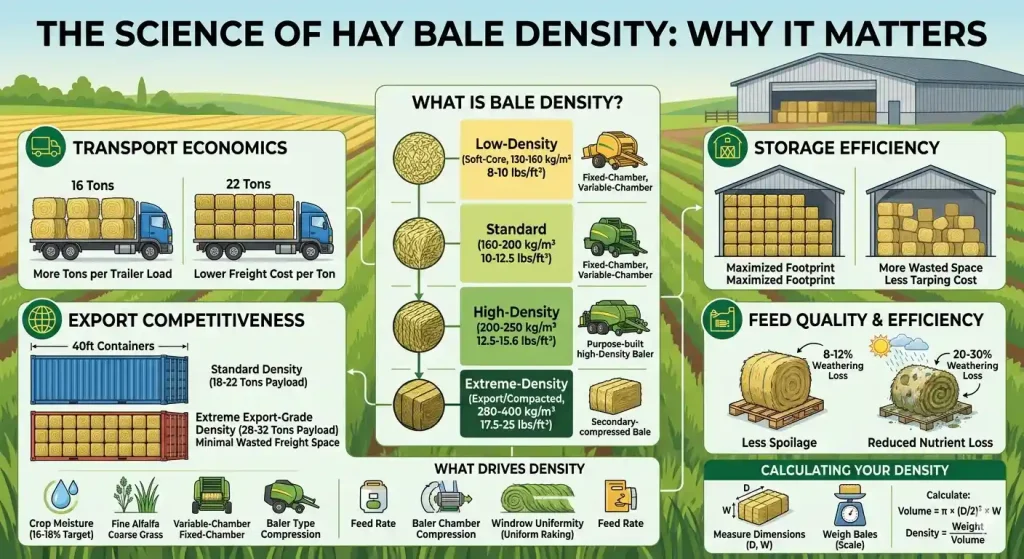
Bale density is mass per unit volume, usually expressed in kg/m³ (metric) or lbs/ft³ (imperial). For reference, typical round bale densities run:
Low-Density (Soft-Core)
130–160 kg/m³ (8–10 lbs/ft³) — typical of fixed-chamber balers or older variable-chamber machines at light compression settings.
Standard
160–200 kg/m³ (10–12.5 lbs/ft³) — typical of modern variable-chamber balers in moderate-duty settings. The mainstream commercial range.
High-Density
200–250 kg/m³ (12.5–15.6 lbs/ft³) — variable-chamber balers with high-compression settings, modern large square balers, or purpose-built high-density balers.
Extreme-Density (Export/Compacted)
280–400 kg/m³ (17.5–25 lbs/ft³) — secondary-compressed bales for export container loading, achieved with hydraulic presses that recompress standard bales.
Why Density Matters: The Economics
Density directly affects four economic variables:
- Transport cost per ton. Trucks and rail cars are volume-limited, not weight-limited, for hay. Denser bales mean more tons per trailer — a 5×6 round bale at 180 kg/m³ weighs ~580 kg; at 220 kg/m³ the same bale weighs ~710 kg. That’s 22% more hay per trailer load.
- Storage cost per ton. Barn space, tarp cost, and footprint are all volume-driven. Denser bales mean more tons per storage dollar.
- Export container economics. International hay shipment uses 40-foot containers, and every cubic meter of unused space is wasted freight cost. Export-grade dense bales are 2–3× as valuable per container as low-density domestic bales.
- Feed-out efficiency. Denser bales present less surface area to air and moisture, reducing weathering and spoilage losses. A tight-core bale stored outside loses 8–12% to weathering; a soft-core bale can lose 20–30%.
What Drives Density
Density isn’t random — specific factors controlled by operator and machine drive the final number:
- Baler chamber compression setting. On variable-chamber balers, operator-adjustable compression pressure directly controls final density. The tradeoff: higher compression means denser bales but more horsepower draw and more driveline stress.
- Baler type. Variable-chamber balers produce denser bales than fixed-chamber designs. Large square balers typically exceed round balers on density. Purpose-built high-density balers (specialty export machines) exceed all standard designs.
- Crop moisture. Hay at 16–18% moisture compresses more tightly than crop at 12% (too dry, brittle stems resist) or 22% (too wet, won’t compact without trapping moisture pockets).
- Crop species and cutting stage. Fine-stemmed early-cut alfalfa compacts denser than coarse late-cut grass. Mixed hay falls between.
- Windrow uniformity. Uniform, consistent-width windrows feed the baler evenly and produce consistent density. Irregular windrows produce irregular bales with internal voids.
- Feed rate. Feeding the baler at its designed capacity produces optimal density. Under-feeding creates soft spots; over-feeding strains the driveline and can damage the baler.
Calculating Bale Density
To calculate your own operation’s bale density:
- Measure bale dimensions. For round bales: diameter (D) and width (W) in meters. Volume = π × (D/2)² × W.
- Weigh representative bales. Five or more bales using a bale scale or loader-mounted scale. Average the weights.
- Divide weight by volume. Density (kg/m³) = average weight (kg) / volume (m³).
Example: a 5×6 round bale (1.52 m diameter × 1.83 m width) has volume 3.32 m³. If it weighs 650 kg, density is 196 kg/m³ — solidly in the standard commercial range. Knowing your number lets you benchmark against competitors, track machine performance over time, and make informed decisions about baler upgrades or compression-setting changes.
The Density-Quality Relationship
A common misconception: higher density is always better. In reality, density interacts with crop moisture and storage conditions in ways that require nuance.
- At correct moisture (16–18%), higher density means better storage quality (less weathering), better transport economics, and no downside.
- At marginal moisture (18–20%), very high density can trap moisture internally, causing center-of-bale heating, mold growth, or in extreme cases spontaneous combustion. Lower density with airflow is safer.
- For silage/haylage (40–60% moisture), density requirements are completely different — tight compaction excludes oxygen to drive fermentation, and density targets run 600–800 kg/m³ rather than 200.
The rule: maximize density only at correct moisture. Baling wet with high compression is a faster path to ruined hay than baling at moderate compression.
Driveline Implications of High-Density Baling
Producing dense bales isn’t free. Higher chamber pressure requires higher hydraulic force, which increases the load on the baler driveline, PTO shaft, gearbox, bearings, and tractor PTO. Operations that habitually run maximum compression see shorter service intervals on all these components. Proper matched components — adequately sized PTO shaft with appropriate slip clutch, properly-specified gearbox with heavy-duty gears, quality bearings — handle the load; under-specified components fail prematurely. For a complete selection of matched driveline components, browse our other product series.
Density Optimization for Export Markets
Export hay requires special consideration. The premium markets (Japan, South Korea, Saudi Arabia, UAE) pay 20–40% above domestic prices but demand compacted bales at 350–400 kg/m³ density. This exceeds what any single-pass baler can produce. Export operators typically bale at standard 180–220 kg/m³ density, then re-compress bales through a secondary press that cuts them into smaller blocks at much higher density. Container loading then fits 28–32 metric tons per 40-foot container instead of 18–22 tons for domestic-density bales.
For producers considering entry into export markets, understanding the hay bale density requirements and the required secondary-press investment is essential. The economics only work at scale — typically 3,000+ tons per year to justify the press equipment.
Field Practices That Raise Density
Even without upgrading the baler, several field practices raise achieved hay bale density:
- Form uniform windrows. A properly set rake creates consistent-width windrows that feed the baler evenly. Our hay rake series offers models tuned for uniform windrow formation.
- Bale at peak moisture. Not 14%, not 20% — target 16–18% consistently.
- Maintain baler belts and chains. Worn belts slip, reducing chamber pressure and bale density.
- Drive at consistent speed. Steady ground speed at the baler’s designed intake rate produces consistent density; variable speed creates density variation.
- Check and adjust compression setting. Variable-chamber balers let operators adjust compression; make sure the setting matches your intended end use.
Density Measurement in Practice: A Worked Example
Consider a typical mid-size commercial operation producing 5×6 round bales. The operator weighs ten representative bales on a platform scale, averaging 675 kg per bale. Bale volume: π × (1.52 m / 2)² × 1.83 m = 3.32 m³. Density: 675 / 3.32 = 203 kg/m³ — solid standard commercial range.
Now compare two neighbors with similar fields and the same crop. Operator A averages 203 kg/m³; Operator B averages 172 kg/m³. Same hay, same field, same weight — but Operator B’s trailer holds 15% fewer tons. Over a season shipping 2,500 bales, that’s 260+ fewer tons delivered in the same truck-loads, meaning 15–20 extra round trips. The equipment difference (belt condition, compression setting, moisture management, windrow uniformity) pays dividends every single delivery.
This is why experienced operators track hay bale density as a management KPI the way dairy farmers track milk per cow. It’s the variable that shows whether everything upstream — mower, rake, moisture, baler — is dialed in together.
Density and Long-Haul Economics
For operations shipping to distant markets, density translates directly to freight cost per ton. A 500-km haul at $3.50/km loaded costs $1,750 per trip. Hauling 16 tons of low-density hay: $109/ton freight. Hauling 22 tons of standard-density hay: $80/ton freight. Hauling 30+ tons of export-density compacted hay: $58/ton freight. The density premium is why export-grade operations justify the capital investment in secondary presses.
Recommended Companion Product
Heavy-Duty Baler Gearbox — High-compression baling stresses the baler gearbox significantly. Our replacement gearbox kits feature hardened-gear construction rated for continuous high-density operation, with 2-year warranty on driveline components.
Upgrade Your Baling for Higher Density, Lower Costs
Explore driveline upgrades, optimized windrow formation, and matched components built for high-density baling.
editor:WM