Flail Mower vs Finish Mower vs Rotary Cutter: What’s the Difference?
Tractor owners looking to maintain land face one of the most confusing decisions in farm machinery: which PTO mower to buy. Three main options dominate the market—the flail mower, the finish mower, and the rotary cutter (often called a “brush hog”). They look superficially similar, all attach to a tractor’s three-point hitch, and all cut vegetation. But each is engineered for a different purpose, and using the wrong one wastes money, time, and sometimes crop quality. This guide compares flail mower vs finish mower alongside rotary cutters so you can match the right tool to your land.
How Each Mower Type Works
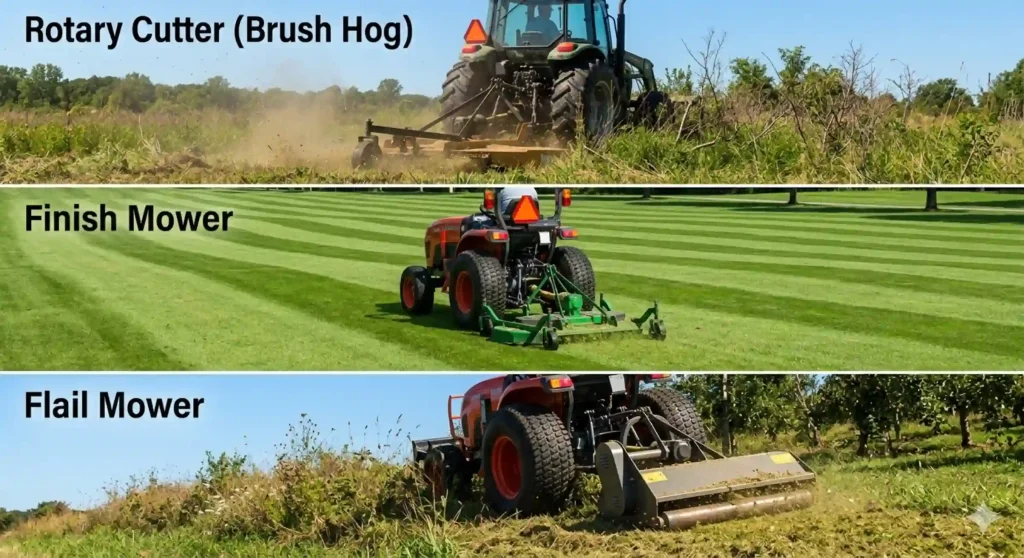
Rotary Cutter (Brush Hog): A heavy-duty mower with two or three large horizontal blades mounted beneath a thick steel deck. Blades spin at 1,800–3,000 RPM and slice through dense brush, small saplings up to 2 inches thick, and tall grass. Designed for rough-cut clearing, not lawn aesthetics.
Finish Mower (Grooming Mower): Uses 2–4 short blades under a low-profile deck with anti-scalp wheels and a rear roller. Blade tip speeds of 10,000–18,000 fpm deliver a golf-course-quality finish on maintained turf. Built for lawns, sports fields, parks, and orchards where appearance matters.
Flail Mower: Uses dozens of small, hinged blades (called “flails”) mounted on a horizontal rotor that spins at high RPM. The blades either cut (Y-blades for grass) or smash (hammer blades for brush). Flails fold back on impact with rocks or stumps, dramatically reducing projectile risk. The cut material is mulched finely and dispersed evenly.
Flail Mower Advantages
- Safety: Dramatically lower projectile risk compared to rotary cutters—critical near roads, buildings, or livestock.
- Fine mulching: Repeatedly strikes cut material, breaking it down for faster decomposition and cleaner appearance.
- Versatility: Handles both tall grass and light brush; switch Y-blades for fine cutting or hammer blades for heavy brush.
- Contour-following: Rear roller follows ground contours, reducing scalping on uneven terrain.
- Reversible operation: Cuts cleanly in both forward and reverse—valuable in tight spaces.
Finish Mower Advantages
- Superior cut quality: Produces the manicured, striped appearance that homeowners, sports fields, and golf courses require.
- Speed: Covers maintained turf faster than a flail—ground speeds of 6–10 mph are common.
- Lower horsepower requirement: A 60-inch finish mower runs well on a 25 HP tractor; an equivalent flail may require 35+ HP.
- Simpler maintenance: 2–4 blades to sharpen or replace, vs. 30+ flails on a flail mower.
- Lower purchase price: Typically 30–50% less than comparable-width flail mowers.
Rotary Cutter Advantages
- Raw cutting power: Handles vegetation that would stop flail and finish mowers—heavy brush, small saplings, multi-year growth.
- Lowest purchase cost: Per square foot of cutting capacity, rotary cutters are the most affordable option.
- Minimal blade wear: Two heavy blades last longer than dozens of flails.
- Simple, rugged: Few failure points make rotary cutters extremely reliable for decades.
Which Should You Choose?
Match the mower to the dominant use case:
- Pure manicured lawn (homes, sports fields, golf courses): Finish mower. Nothing cuts a lawn as beautifully.
- Pasture/field with tall grass and light weeds: Rotary cutter or flail. Rotary cutter if cost matters most; flail if appearance matters.
- Roadside, orchard, vineyard, ditch bank: Flail mower. Safety and fine mulching make it the clear choice.
- Heavy brush, saplings, multi-year overgrowth: Heavy-duty rotary cutter. Flails can handle light brush but struggle with dense woody material.
- “I need one mower that does everything reasonably well”: 60-inch 3-point flail mower. It’s the best single-tool choice for most 25–50 HP tractor owners.
Matching Horsepower to Deck Width
One of the most common mistakes is pairing an undersized tractor with an oversized mower. As a rule of thumb:
- 25–35 HP tractor → 48–60 inch deck
- 40–50 HP tractor → 60–72 inch deck
- 50–75 HP tractor → 72–84 inch deck
- 75–100 HP tractor → 84–96 inch deck
Flail mowers generally need more HP per inch of deck width than finish mowers due to higher rotor mass and continuous contact with material. If you maintain a mix of turf and rough ground, a flail mower paired with the right rake from our Seri Penggaruk Jerami can even double as hay-conditioning equipment in light operations.
The Hidden Cost: Blade Wear & Replacement
Rotary cutter blades are the cheapest to replace but wear fastest on rocky ground. Finish mower blades last moderately long and cost little per blade, but there are fewer of them. Flail mowers have the highest total blade count—36–60 flails on a 6 ft machine—but individual blades are inexpensive and replacement is straightforward with simple hand tools. And while you’re planning your mower purchase, consider your full haymaking equipment chain—see compatible hay balers in our Seri Mesin Pengepak Jerami.
Pertanyaan yang Sering Diajukan
Can a flail mower cut tall hayfield grass for haymaking? Technically yes, but flail mowers chop the crop into short fragments that are difficult to rake and bale. Dedicated disc mowers or sickle mowers produce uniform swaths better suited to haymaking.
How long do flail blades last? Y-blades typically last 100–300 hours depending on soil contact and rock content. Hammer blades last 200–500 hours. Rocky terrain dramatically shortens blade life. Always replace flails in balanced pairs opposite each other on the rotor.
Is a finish mower safe on steep slopes? Finish mowers with rear rollers follow contours reasonably well on moderate slopes, but steep terrain (more than 15°) is better handled by flail mowers with their lower center of gravity and reduced projectile risk.
What’s the best all-around single mower for a 40 HP tractor? A 60-inch 3-point flail mower with Y-blades. It handles lawn-quality cutting on turf, tall grass in pasture, light brush along fence lines, and roadside trimming—covering 90% of use cases for a mid-size tractor owner.
Do flail mowers need more horsepower than finish mowers? Typically yes, because of the heavier rotor and continuous material contact. A 72-inch flail may require 40+ HP while a 72-inch finish mower runs on 30 HP.
Quick Selection Summary
- Mostly lawn-quality turf + occasional pasture: Finish mower on smaller tractor, rotary cutter on bigger tractor.
- Mixed turf + pasture + roadside + brush: Flail mower is the single best choice.
- Heavy brush and pasture reclamation: Heavy-duty rotary cutter with shielded gearbox.
- Tight spaces and precision cutting: Flail mower with side-shift hydraulics.
- Orchard floor management: Flail mower with low-profile deck.
Total cost of ownership over 10 years typically favors the flail mower for mixed-use operations, while finish and rotary mowers remain specialized tools for their dedicated use cases. Before purchasing, test-run the specific model you’re considering on your own ground—data sheets tell only part of the story, and actual cut quality, vibration, and operator feel vary meaningfully between brands even at similar published specifications.
Long-Term Cost Considerations
Beyond initial purchase price, consider 10-year total cost of ownership when selecting a mower. Flail mowers carry higher blade-replacement costs but deliver exceptional versatility, often eliminating the need for multiple specialized implements. Rotary cutters have the lowest blade cost but typically wear out gearboxes faster due to heavy impact loading. Finish mowers have the lowest per-hour operating cost but the narrowest use case. For most diversified farms, a single flail mower that handles 80%+ of cutting tasks provides better overall economics than maintaining two or three specialized implements, despite the higher initial investment.
Recommended Related Product
🛠️ PTO Shaft with Slip Clutch for Flail Mower: High-inertia flail rotors require slip clutch protection to prevent driveline damage when the blades encounter rocks or stumps. Our flail-mower PTO shafts feature factory-calibrated slip clutches and heavy-duty U-joints rated for continuous severe-duty use.
Get Expert Help Choosing Your Mower
Still deciding between flail, finish, and rotary? Tell us about your tractor, acreage, and the types of vegetation you need to manage, and we’ll recommend the ideal mower configuration. We supply dealers and end users worldwide with durable, competitively-priced PTO mowers.