Hay Export Market 2026: What International Buyers Look For
Global hay trade has evolved from a niche business into a $3.5+ billion annual market, with premium hay flowing from major production regions (US, Spain, Canada, Australia) to import-dependent dairy economies (Japan, South Korea, UAE, Saudi Arabia, China). For producers and traders considering entry into the hay export market, 2026 offers both strong opportunities and substantial complexity. This guide lays out the market structure, buyer requirements, competitive positioning, and infrastructure needs that determine success in international hay trading.
Market Size and Major Trade Flows
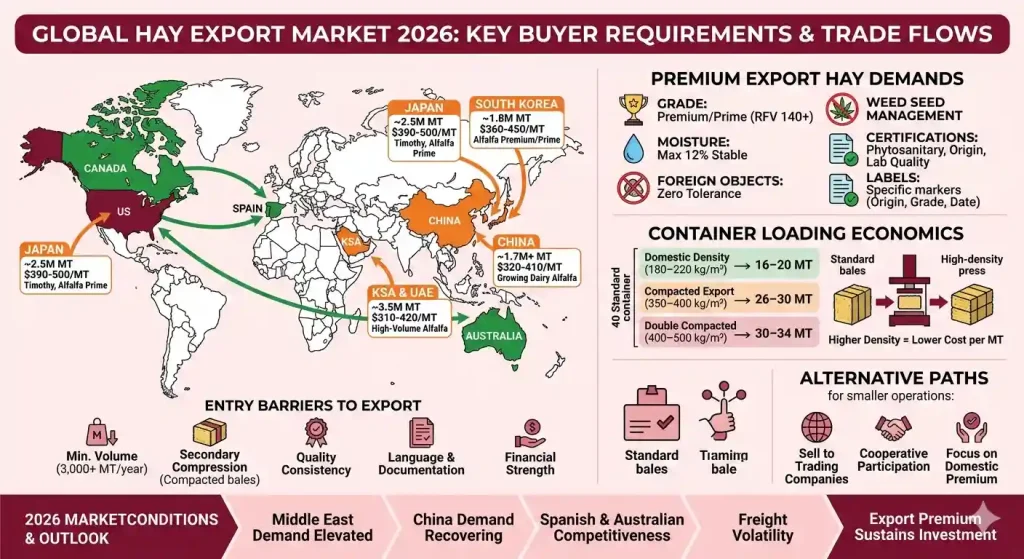
The global hay trade in 2026 is estimated at approximately 10–12 million metric tons annually, distributed across these major flows:
🇯🇵 Japan — The Premium Market
Annual imports: ~2.5 million MT. Typical pricing: $390–500/MT landed.
Dominant buyer of Prime timothy and premium alfalfa. Quality standards extremely high — moisture stability, leaf retention, color consistency. Major suppliers: Washington state US, Oregon, Idaho, Alberta Canada.
🇰🇷 South Korea — Strong Dairy Demand
Annual imports: ~1.8 million MT. Typical pricing: $360–450/MT landed.
Mainstream Premium and Prime alfalfa for dairy industry. Quality expectations similar to Japan but price-sensitivity slightly higher. Major suppliers: US West Coast, Spain.
🇸🇦 Saudi Arabia & 🇦🇪 UAE — High-Volume Dairy
Annual imports (combined): ~3.5 million MT. Typical pricing: $310–420/MT landed.
Following domestic water-scarcity restrictions on alfalfa production (2019 onward), Gulf states became massive hay importers. Primarily Premium alfalfa for very large dairy operations. Major suppliers: US, Spain, Argentina.
🇨🇳 China — Growing Dairy Sector
Annual imports: ~1.7 million MT and growing. Typical pricing: $320–410/MT landed.
Expanding dairy industry drives alfalfa demand. Timothy hay demand growing in horse and specialty livestock. Major suppliers: US, Spain, Canada, Australia.
🌍 Other Markets — Regional Scale
Combined: ~0.8 million MT. Typical pricing: Varies widely.
Taiwan, Vietnam, Philippines, Indonesia, Jordan, and smaller imports for specialty markets. Includes horse-hay exports to Europe and Middle East.
What Premium Export Markets Demand
Premium export hay must meet specifications that domestic operations rarely encounter. The core requirements:
- Quality grade: Premium or Prime only. RFV 140+ for alfalfa; visually bright-green color for timothy. Lab-tested with third-party certification is typical.
- Moisture consistency: Max 12% moisture. Bales must maintain stable moisture through 30–60 days ocean transit and 60–120 days in-country storage.
- Foreign-object freedom: Essentially zero tolerance for rocks, baler twine fragments, metal, animal remains. Random container inspections can reject entire shipments.
- Weed-seed management: Many importing countries require certification that no restricted weed species (thistles, nightshade, etc.) are present.
- Compacted bale density: Standard bales re-compressed to 350–420 kg/m³ via secondary press. Required for container economics.
- Phytosanitary certification: Government-issued phytosanitary certificate required by most importers.
- Labeled packaging: Bales tagged or marked with origin, grade, moisture, harvest date, lot number.
Hay Export Standards and Certification
Beyond grade, international trade has formal hay export standards that apply:
- Phytosanitary certificate: Issued by national plant-health authority (USDA APHIS in US). Confirms freedom from regulated pests. Required for virtually all importing countries.
- Certificate of origin: Required for tariff classification. Issued by chamber of commerce or equivalent.
- Quality certification: Third-party lab test results (NIR or wet chemistry) reporting CP, ADF, NDF, moisture, RFV. Attached to shipping documents.
- Fumigation certificate: Some countries require methyl bromide or equivalent fumigation treatment before or at arrival. Documentation required.
- Country-specific requirements: Japan requires weed-seed freedom certificate. Saudi Arabia requires Arabic documentation. China has specific processing-facility registration requirements.
Container Loading Economics
Export hay travels by 40-foot standard containers. Each container holds:
- Domestic-density round bales (180–220 kg/m³): 16–20 MT per container
- Compacted small square bales (350–400 kg/m³): 26–30 MT per container
- Double-compacted bales (400–500 kg/m³): 30–34 MT per container
Freight cost ($3,500–6,500 per container depending on route and season) is relatively fixed per container. Higher density means lower cost per MT shipped — which is why export-grade operations invest in secondary-compression presses that turn standard bales into high-density export bales. Payback on a $350,000–600,000 export press typically runs 3–5 years at commercial export volumes.
Entry Barriers to Export
Direct exporting has meaningful entry barriers that limit participation to mid-large operators or organized cooperatives:
- Minimum viable volume: 3,000+ MT annual export volume to justify compression press, loading infrastructure, and administrative overhead. Below this scale, selling to export trading companies is more economical than direct export.
- Secondary compression equipment: Essential for container economics. Can be purchased outright, leased, or accessed through export-processor partnerships.
- Quality consistency: Export buyers expect year-after-year consistent quality. Inconsistent quality loses contracts quickly.
- Language and documentation: International trade requires multilingual documentation, customs compliance, and foreign-currency invoicing. Most operations outsource to export agents.
- Financial strength: 60–120 day payment terms (sometimes longer) are standard. Producers need working capital to carry receivables.
Alternative Paths into Export Markets
For smaller operations, three paths into the export economy are more accessible than direct export:
- Sell to export trading companies: Major hay exporters like Anderson Hay, ACX, Standlee, and regional equivalents buy from mid-size operations at 10–15% below export FOB prices. The exporter handles all compression, logistics, and international sales. Simpler but lower margins.
- Regional cooperative participation: Alfalfa cooperative exports (eg, various Washington State hay producer organizations) pool output from members, achieve export volume, and share returns. Requires membership and quality compliance.
- Quality positioning for domestic premium markets: Some operations choose to produce export-grade quality but sell domestically to racehorse farms, high-end dairy operations, and specialty livestock. These markets pay 30–60% above commodity hay prices without international complexity.
Production Decisions for Export Orientation
Operations targeting export markets make different production decisions than domestic-focused operations:
- Crop selection: Alfalfa (Prime grade) and timothy are premium export crops. Grass hay mixes, orchardgrass, and fescue have smaller export markets.
- Cutting timing: Earlier cutting (pre-bloom alfalfa) to achieve Prime grade. Sacrifices 10–20% yield for premium quality.
- Weather risk management: Tight curing windows with conservative cutting timing. Rain-damaged hay sells domestically, not export.
- Storage infrastructure: Covered storage only. Export buyers reject any evidence of weather exposure.
- Handling equipment: Reliable baler and quality-optimizing rake setups. Our hay rake series includes rotary rakes designed for leaf preservation critical to Prime-grade exports.
2026 Market Conditions and Outlook
As of early 2026, international hay trade shows these trends:
- Elevated demand from Middle East continuing as Gulf states expand dairy capacity post-water-restriction policies
- China demand recovery from earlier trade friction; Chinese importers actively seeking diversified supply
- Japan premium market stable at high prices; aging dairy industry consolidating buyer relationships
- Spain and Australia emerging as competitive suppliers to Middle East and Asia markets
- Freight cost volatility remains an issue; fuel surcharges and port congestion affect competitiveness month-to-month
- Export-grade premium running 20–40% above comparable domestic-grade prices — sustaining investment in export infrastructure
For producers considering export-orientation: the international hay export market rewards sustained quality investment but punishes inconsistency. Building export relationships takes 3–5 years of consistent supply performance. The reward for making it through that development period is a more stable, higher-margin business than commodity domestic hay.
For operations wanting to equip for export-grade production, quality-optimizing driveline components, bale wrap materials, and moisture-monitoring tools are essential. Our other product series stocks the supporting equipment that makes consistent export-grade production achievable.
Risk Management in International Hay Trade
The hay export market presents risks that domestic sales don’t. Successful exporters manage them proactively:
- Currency risk: Contracts denominated in USD shield US producers from exchange-rate movements but push risk to foreign buyers. Contracts in buyer’s currency (JPY, KRW, SAR) put risk on the producer. Forward currency contracts via commercial banks hedge this exposure for significant contracts.
- Political and trade policy risk: Tariff changes, import-permit modifications, and political tensions between countries can disrupt established trade flows quickly. Diversifying customer base across multiple importing countries reduces concentration risk.
- Phytosanitary rejection risk: A single rejected container can cost $30,000–60,000 in freight, inspection, and disposal. Rigorous pre-shipment quality control and supply-chain discipline minimize this risk.
- Payment risk: 60–120 day payment terms are standard. Letter-of-credit or documentary-collection payment methods transfer risk to issuing bank. New-customer relationships should require LC backing until payment history is established.
- Logistics and container availability: Pandemic-era container shortages demonstrated how logistics disruption can idle exports. Maintaining relationships with multiple freight forwarders and having storage capacity to hold product during transport delays reduces exposure.
Buyer Relationship Development
Long-term international hay trade relationships are built on trust developed over years. In-person visits to buyer operations (Japan, Korea, Middle East) during off-season months is common practice for serious exporters. Understanding buyer-market quality expectations, feeding practices, and competitive alternatives helps position supply offerings. Customer loyalty in international hay markets tends to be high once trust is established — but initial acceptance typically takes 2–3 seasons of consistent performance.
Recommended Companion Product
Export-Grade Bale Wrap / Secondary Press Components — UV-stabilized multilayer wrap films for high-density export bales. Replacement rolls, cutter blades, and bearing kits for secondary-compression press equipment. Matched to Japanese, Korean, and Middle East buyer specifications.
Equip for Export-Grade Production — Enter the Premium Global Market
From secondary-press components to premium wrap materials to quality-optimizing rakes — we supply the tools that compete internationally.